

Turn bank AI inventory, control and monitoring records into cited use-case cards aligned with the OCC's November 4 examiner framework.
What the OCC actually issued on November 4
The Office of the Comptroller of the Currency issued Bulletin 2026-54 on November 4 with a supervisory framework for examiners evaluating banks' use of what the OCC now calls “super intelligence,” a term that includes technologies previously described as artificial intelligence. Reuters independently reported the release the same day, giving the topic current public attention.
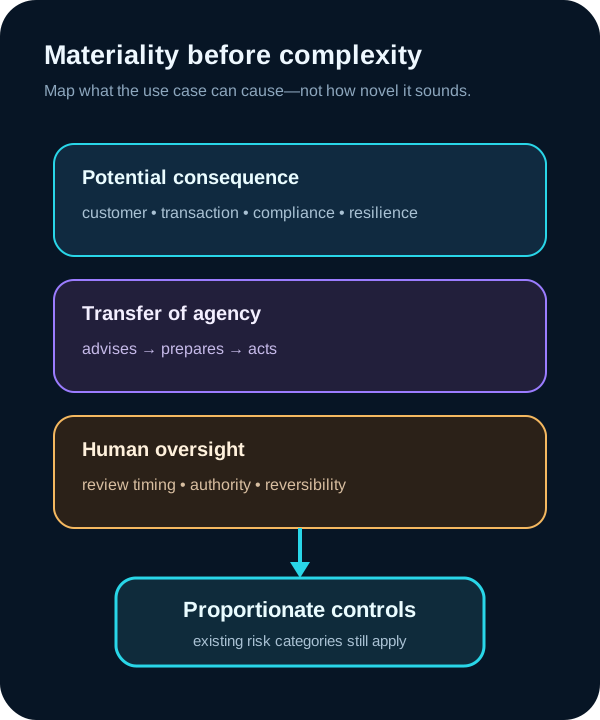
The bulletin is unusually explicit about its limits: it does not establish new supervisory expectations, enforceable standards, prescriptive requirements or a requirement that banks assess themselves against the document. Examiners should tailor work to the materiality of the use case and the bank's size, complexity and risk profile.
The practical opportunity is therefore evidence organization, not a new compliance checklist. A bank can use AI to reconcile its existing use-case inventory, policies, tests and monitoring into consistent cards that help owners answer questions about consequence, agency and oversight.
- Problem: AI use cases and supporting controls are scattered across business, model-risk, technology and vendor records.
- Audience: bank technology, cybersecurity, compliance, model-risk, internal audit and business owners.
- Output: an owner-attested use-case card with evidence pointers and visible gaps.
Build the register from existing systems of record
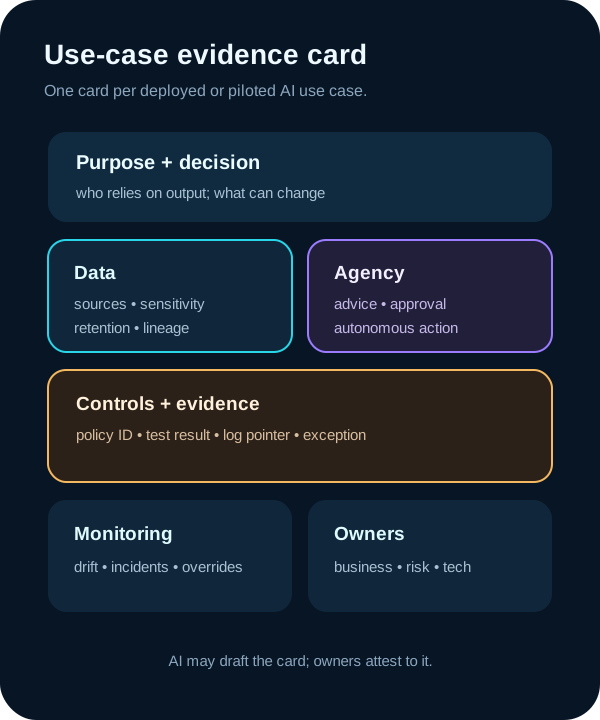
Start with the systems already authoritative for applications, models, vendors, data, incidents and controls. Create one stable use-case ID and link the business purpose, decision supported, deployment status, owner, user population, affected products, data sources, vendor, model or service version and production boundary.
Add fields for potential consequences, whether output is advisory or can cause an action, the timing of human review, reversibility, customer or transaction impact, monitoring, incident history, overrides and open exceptions. Link policy, test, change and approval evidence rather than copying sensitive records into the model workspace.
Do not treat technical sophistication as the risk score. A simple classifier that can initiate or block a transaction may warrant more control than a sophisticated assistant summarizing internal notes.

- Inventory source: application, model, vendor and data catalogs.
- Evidence source: approvals, tests, monitoring, incidents, overrides and exceptions.
- Attestation: named business, technology and risk owners with a review date.
Use AI for reconciliation, not regulatory judgment
Export minimized records with stable IDs and a closed schema. Ask the assistant to identify conflicting owners, missing control links, stale review dates, inconsistent deployment status and use cases whose agency or consequence changed after a release. Do not ask whether the bank is compliant or whether an examiner will accept the controls.
Example prompt: “Reconcile these use-case records using the supplied field definitions. Preserve every record and evidence ID. Flag contradictions, missing owners, missing evidence, stale reviews and changes in consequence, agency or human oversight. Cite the IDs behind every flag. Do not create a control, infer approval, rate regulatory compliance or apply the OCC guide as a bank requirement.”
Expected output is a proposed exception list and normalized card draft. Each owner reviews the underlying records, corrects the system of record and attests to the final card.
Prepare a traceable examination packet
For a selected use case, generate an index that maps each statement to the authoritative policy, test, monitoring record, change ticket or exception. Include the use-case owner, system boundary, current production status, material changes, incident and override history, and the next review date.
Keep privileged legal analysis, customer data and examiner communications outside an unapproved assistant. Provide access-controlled links or redacted extracts. Record the prompt version, data snapshot, output hash and human edits so the packet can be reproduced.
When the evidence is missing, say so. A concise gap with an owner and due date is more defensible than a completed-looking card built from assumptions.

Test proportionality with a cross-functional tabletop
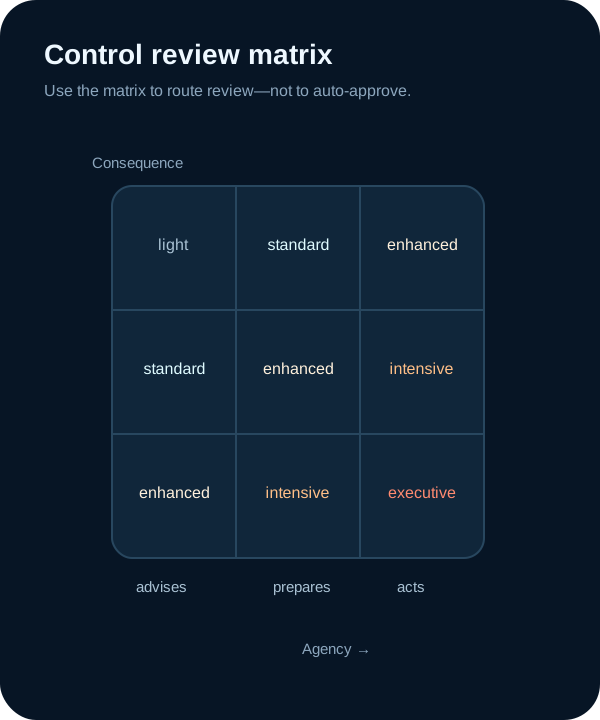
Choose six representative use cases: internal summarization, customer communication, fraud or transaction support, software development, an agent that prepares actions and an agent that can execute an approved action. Ask business, technology, cybersecurity, compliance and model-risk owners to independently describe consequences, agency and oversight.
Use AI only to compare the answers and expose disagreements. Review whether higher-consequence or more autonomous use cases have stronger pre-deployment testing, access controls, monitoring, escalation and rollback. Keep the decision in the governance forum.
Track unresolved owner conflicts, missing evidence, stale monitoring and the time required to reproduce a card. The goal is a more coherent inventory, not a universal risk number or a guarantee about an examination outcome.
Limitations and governance boundaries
An inventory is only as complete as discovery and change management. Shadow tools, embedded vendor features, renamed models and dormant pilots can escape the register. A model can also normalize away a meaningful exception or infer an owner from an outdated record.
The OCC framework supplements existing governance, model-risk, technology, compliance and operational-risk practices; it does not make AI a separate risk category or require a separate AI risk appetite. Banks outside OCC supervision may face different regulators, laws and contractual obligations.
Treat the assistant as a reconciliation aid. Internal audit, counsel, compliance and accountable business leaders retain their existing roles, and the source bulletin should be read directly before an examination or policy change.
Put the insight into practice.
Deep Security helps organizations assess risk, validate controls, and build a practical plan to strengthen their defenses.
Talk with Deep Security