

Turn Android inventory, OEM support and managed-device exports into a cited patch queue without letting AI guess exposure or enforce updates.
Why the November Android bulletin needs an evidence workflow
Google published the November 2026 Android Security Bulletin on November 2. It says security patch levels of 2026-11-05 or later address all issues in the bulletin, while the 2026-11-01 level covers the first group. The most severe issue is a critical Framework vulnerability that could allow remote code execution without user interaction or additional execution privileges.
SecurityWeek independently reported on the bulletin this week and counted more than 200 fixes across the two patch levels, including critical issues in Framework, System and several hardware components. That fresh primary publication plus prominent independent coverage establishes current attention; it does not prove exploitation, fleet exposure or search demand.
For managed IT and mobile-security teams, the practical AI use case is not vulnerability scoring. It is reconciling many device, owner, OS, vendor-build and patch-level records into a cited exception ledger that humans can verify.
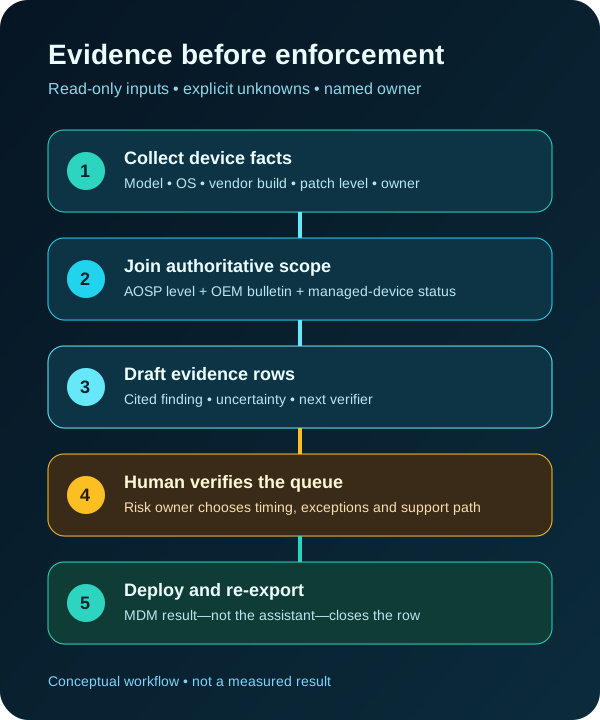
- Problem: a fleet export may show a date but not whether a device's exact vendor build is supported or fully addressed.
- Audience: endpoint administrators, MSPs, security operations and application owners with managed Android devices.
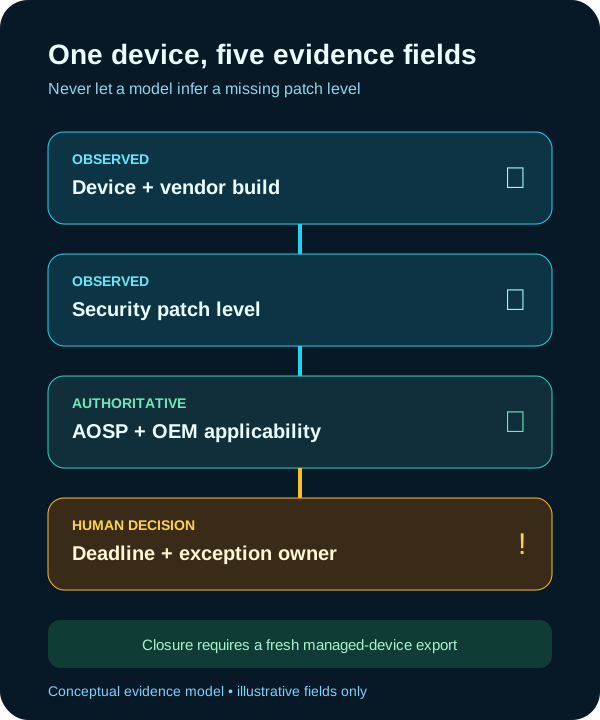
- Output: one evidence row per device with observed facts, authoritative scope, uncertainty, owner and next action.
Collect device facts without opening a write path
Export a bounded fleet snapshot from the existing mobile-device management system. Keep the device ID pseudonymous and include only the fields needed for the decision: model, manufacturer, OS version, vendor build, Android security patch level, management state, last check-in, business owner, support status and update channel.
Join the Google bulletin with the exact OEM security advisory and support matrix for each model. The AOSP patch date is necessary but not sufficient: manufacturers integrate component fixes on different schedules, and a stale or unsupported device may require a compensating control or replacement rather than a generic update command.
Give the assistant read-only, minimized exports. Do not provide enrollment tokens, device certificates, recovery keys, user content or MDM write credentials. Preserve the source export and query time so an old snapshot cannot masquerade as current fleet state.

- Fleet export: device, build, patch level, owner and last check-in.
- Authoritative scope: AOSP bulletin plus the exact manufacturer advisory.
- Business context: critical apps, travel or field constraints, replacement path and exception owner.
Prompt for reconciliation, not a verdict
Use a closed output schema. Every row should retain the source device ID, observed patch level, applicable bulletin and OEM references, support status, known unknowns, proposed next verifier and accountable owner. Require the model to say “unknown” when the vendor build or manufacturer bulletin is missing.
Example prompt: “Using only the supplied MDM and advisory rows, build an exception ledger. Cite the source row for every device fact and the advisory ID for every applicability statement. Separate observed, authoritative and inferred fields. Flag stale check-ins, unsupported models, missing OEM guidance and patch levels earlier than the approved threshold. Do not mark a device exposed, deploy an update, change policy or close a row.”
The expected output is an illustrative review queue, not a scanner finding. An endpoint administrator opens the cited records, confirms the exact device state and chooses the rollout, exception or replacement path.
Route field constraints and unsupported devices to owners
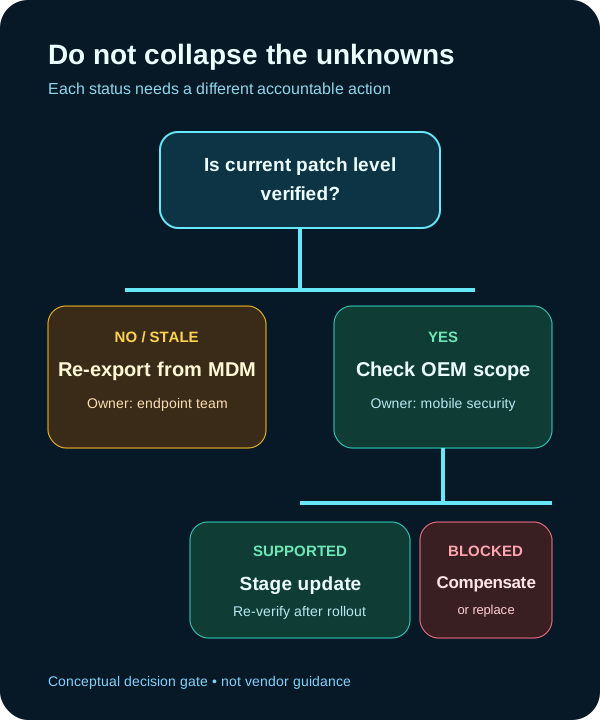
Group the reviewed rows by action, not by a model-generated risk score: eligible for staged update, waiting for an OEM release, stale or offline, business-blocked, unsupported or unknown. Give each group a named owner, due date, validation method and escalation path.
Use a pilot ring of noncritical devices that represents the actual manufacturers, OS branches and business apps in the fleet. Verify enrollment, application launch, authentication, VPN, messaging and support workflows before expanding. Keep rollback or replacement decisions in the established change process.
Field devices may be offline, on metered networks or supporting safety-sensitive work. The assistant can summarize these constraints, but it cannot decide that a missed check-in is malicious or that a business interruption is acceptable.

Verify the rollout with a fresh export
After the staged deployment, take a new read-only export and compare it with the baseline. Require a fresh device check-in and the expected vendor build and patch level. A successful MDM task or user acknowledgment is not proof that the device reached the intended state.
Track coverage, stale devices, unsupported models, failed updates, business exceptions, evidence age and the time required to reproduce each row. Set thresholds from your own fleet baseline. Deep Security did not run this workflow or test the November fixes.
Close only the rows with verified current evidence. Unknown or unsupported devices should remain open with a compensating control, owner and replacement date.
Limitations and safe boundaries
Patch level alone does not describe every device's security posture. OEM backports, carrier variants, hardware components, Google Play system modules, unsupported devices and delayed check-ins can change the answer. The November bulletin also describes severity under stated assumptions; it does not claim every listed issue is actively exploited.
A model may confuse the two Android patch levels, count duplicate CVEs or generalize one manufacturer's guidance to another. Treat every generated applicability statement as a proposed join that must retain its authoritative reference.
This workflow improves fleet evidence. It does not replace MDM, OEM guidance, application testing, change control, incident response or an administrator who can validate the exact device.
Put the insight into practice.
Deep Security helps organizations assess risk, validate controls, and build a practical plan to strengthen their defenses.
Talk with Deep Security