

A practical SOC workflow for reconstructing AI-driven attack sequences from patch, identity, endpoint, cloud and network evidence while keeping containment human-controlled.
Why agentic intrusion triage has current attention
Google Threat Intelligence Group published a November 16 report describing what it called a threshold change in operational threat activity: multiple public and private frameworks coordinating reconnaissance, vulnerability analysis, exploitation and follow-on actions. GTIG named ARTEX, CAIRN, CyberStrikeAI, PentAGI and HexStrike AI, and described an exploit_agent that compared patched and unpatched code, identified vulnerabilities and developed or executed exploits without human involvement. Those are GTIG observations; Deep Security did not reproduce the activity or verify an affected environment.
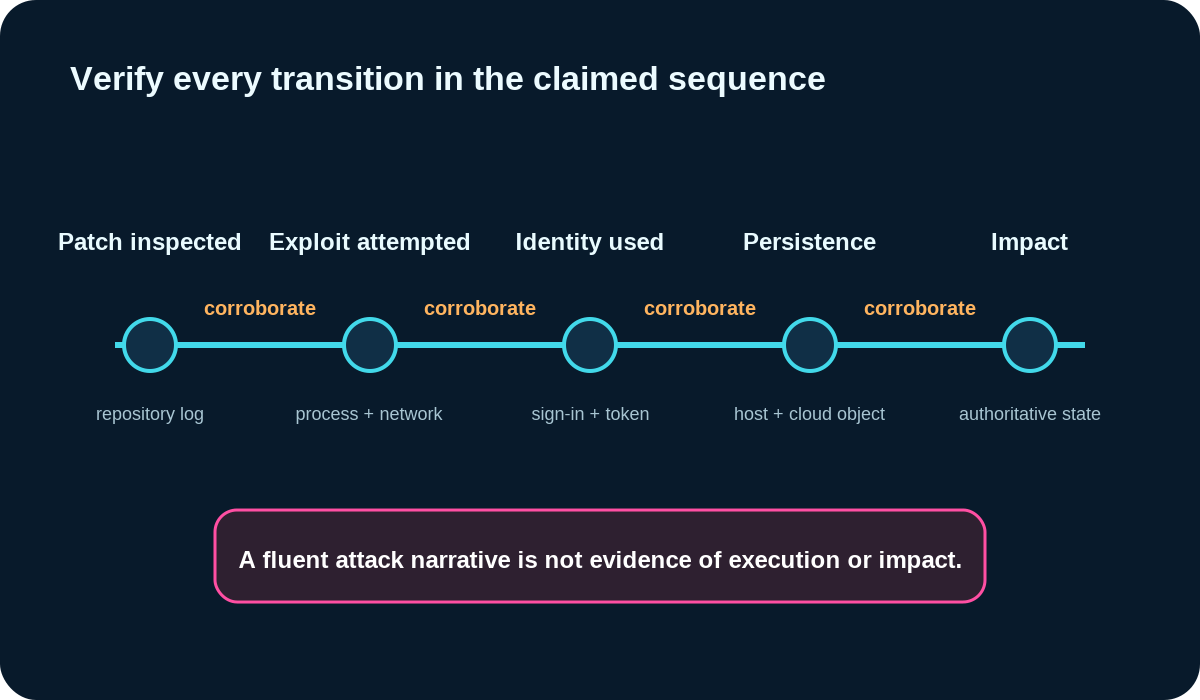
Independent coverage followed on November 17 and 18 from SecurityWeek and The Register. The practical SOC problem is not whether the attacker used an impressive model. It is that automation can create many partially successful actions, failed exploit attempts and misleading artifacts faster than an analyst can review them. The defender needs a sequence that distinguishes code analysis from execution, execution from access, access from persistence and persistence from impact.

Audience, tools and a safe investigation boundary
This workflow fits SOC analysts, incident responders, cloud defenders, detection engineers and secure-development teams investigating suspicious exploitation or multi-stage automation. A pilot needs access to approved patch and repository history, identity sign-ins, endpoint process data, cloud audit logs, network telemetry, a case system and immutable evidence storage. The AI assistant should read a curated evidence set through a service account and return source IDs and timestamps.
Do not give the model an exploit tool, unrestricted shell, production credential or authority to isolate systems. Its job is correlation: normalize time, connect stable object IDs, propose competing sequences and list missing evidence. Analysts retain legal scope, malware handling, containment, eradication, recovery and notification decisions.
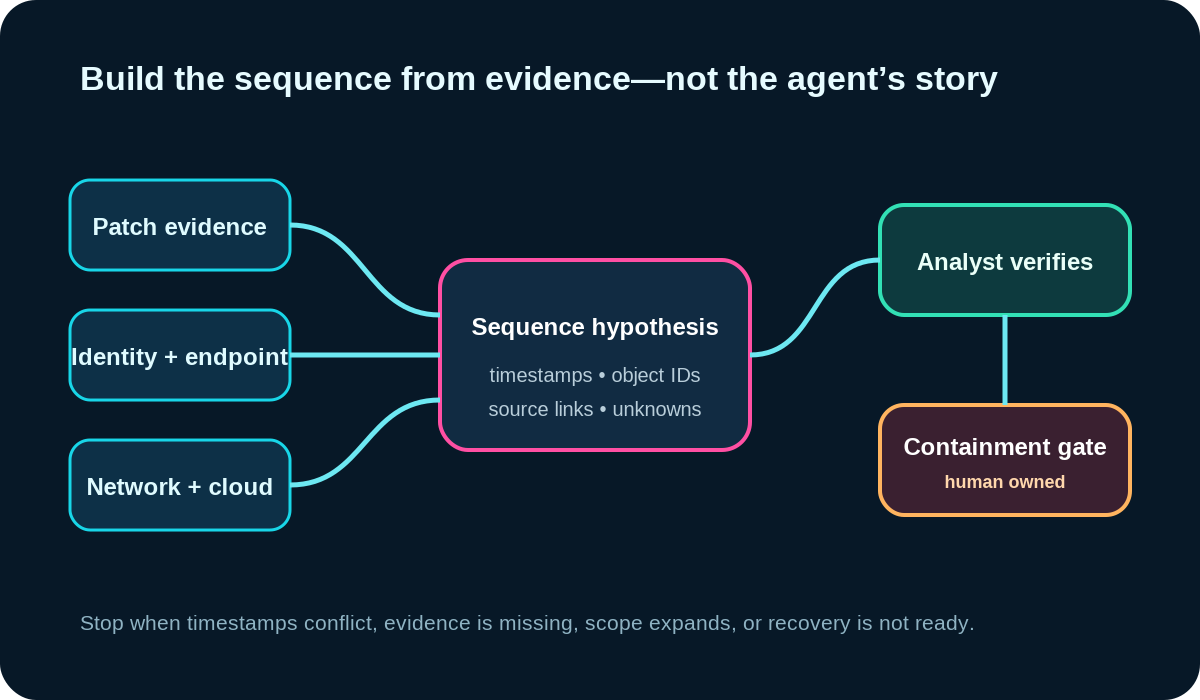
- Observation: a recorded event with source, timestamp, object and collection method.
- Inference: a labeled relationship supported by one or more observations.
- Unknown: evidence needed to confirm or reject the inference.
- Decision: a human-owned action with authority, impact and rollback.
Step 1: anchor the case to authoritative events
Start with a narrow hypothesis and window, such as “Was internet-facing service S-17 exploited between 02:00 and 04:00 Central, and did that access reach workload identity W-9?” Export the relevant patch diff, deployment time, web and process events, workload-token use, cloud control-plane changes and egress records. Preserve raw originals before normalization.
Convert timestamps to one timezone without discarding the original value. Join on stable asset, process, account, token and request identifiers rather than display names. Keep expected administrative activity in the same window so the assistant must compare alternatives instead of labeling every unusual event malicious.
Step 2: ask for competing sequences and evidence gaps
Example prompt: “Using only case IR-218 evidence, produce up to three candidate sequences from initial access to impact. For every step, cite the evidence ID, original timestamp, asset or identity ID and confidence reason. Separate observed events from inference. Identify missing telemetry, clock conflicts and benign alternatives. Do not run code, visit attacker infrastructure, infer attribution, recommend destructive action or declare compromise without an authoritative state change.”
Expected output is a compact table or case packet: candidate sequence, supporting events, contradicting events, unresolved gaps and the next safe query. Reject outputs that cite no source, collapse multiple identities into one actor or convert an exploit attempt into confirmed execution.
- Require at least one contradicting or benign alternative where evidence permits.
- Treat staging-server artifacts as leads until victim telemetry corroborates them.
- Record model, prompt version, evidence manifest and reviewer correction.
- Preserve uncertainty; do not turn confidence language into a severity score.
Step 3: gate containment with recovery evidence
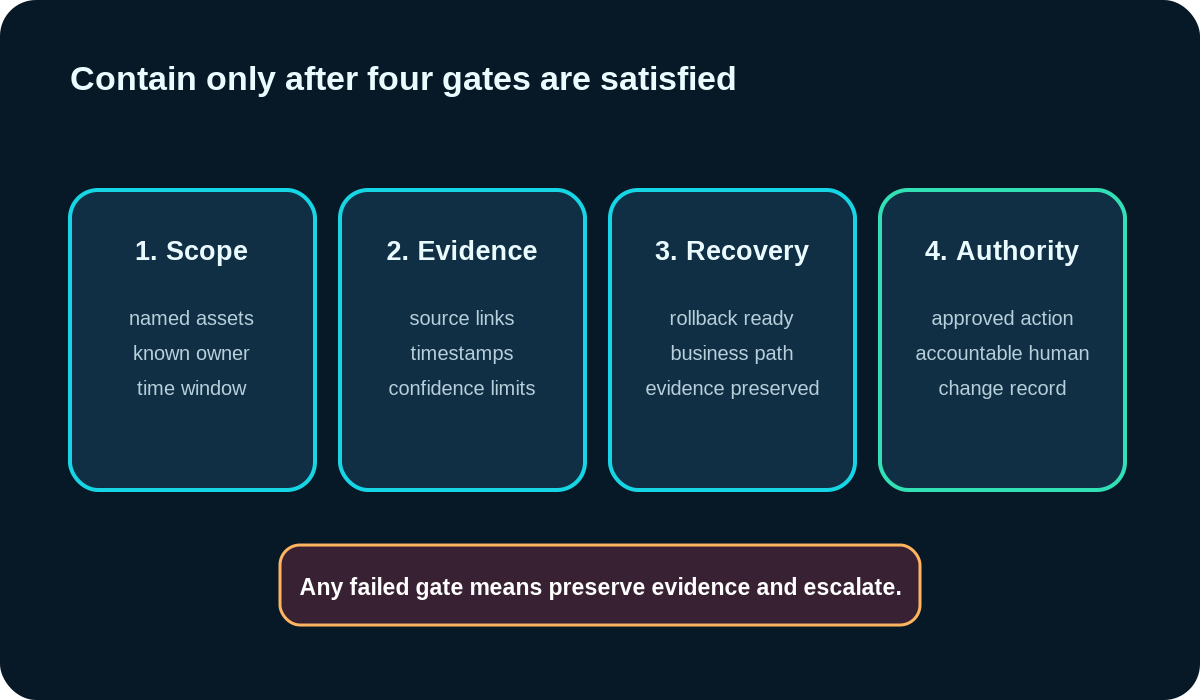
Before isolation, token revocation, firewall change or service shutdown, the reviewer should see the exact target, evidence supporting risk, expected business impact, preservation status, recovery owner and rollback. A model can draft this packet, but it cannot supply missing authority.
Begin with reversible actions in a test or low-impact segment. Keep a separate approver for production identity and network changes. Stop when the asset owner is unknown, the sequence crosses the approved scope, the evidence store is incomplete or the recovery path has not been tested.

Step 4: validate detections against the sequence
After the case is contained, map each confirmed transition to an existing detection or logging gap. Replay approved synthetic events or sanitized case traces in a lab. Measure evidence coverage, time to assemble the sequence, analyst corrections, unsupported claims and containment reversals—not the model’s prose quality.
If a model repeatedly bridges the same missing step, improve collection or make the gap explicit in the playbook. Do not compensate by giving the assistant more production access. Retain a no-AI path for sensitive incidents, outages or evidence that cannot be sent to the selected service.
Realistic limitations and why this topic was selected
Attack frameworks can hallucinate, fail noisily or leave artifacts that exaggerate their capability. Defender models can also merge actors, invent causality or miss telemetry outside their context. Tool output, memory and attacker-controlled text are untrusted inputs. Independent forensics, authorization, legal review and recovery planning remain necessary.
A focused Firecrawl search on November 18 for “Google GTIG agentic threat activity significant threshold November 16 2026” returned the primary report first and multiple fresh independent articles from November 17 and 18, including SecurityWeek and The Register. That dated cluster established current public attention and a direct fit for Deep Security’s incident-response audience. Search placement is a discovery signal, not proof of traffic, adoption or Google rank.
Put the insight into practice.
Deep Security helps organizations assess risk, validate controls, and build a practical plan to strengthen their defenses.
Talk with Deep Security