

Build a cited AI agent timeline across prompts, tool calls, endpoint processes, files and network effects while keeping containment decisions human-owned.
Why the prompt-to-process gap matters now
CrowdStrike's October 30 Agent Graph article describes a way to connect prompts, models, tools, skills and MCP servers with endpoint processes, files, network connections and detections. The company says its views can inventory agents, graph sessions and score threats, with hooks for Claude Code, OpenAI Codex, GitHub Copilot, OpenCode and Cursor available at publication. Those are vendor claims; Deep Security did not test the feature.
Falcon Guardian itself was announced on September 1. The fresh October 30 material is useful because it makes an operational problem concrete: agent-layer logs and endpoint telemetry often live in separate systems. This article applies that current idea as a vendor-neutral investigation workflow rather than presenting an older launch as a new product.
The exact Firecrawl search placed the new primary article first and surfaced an official demonstration plus secondary discussion. That is a current-attention signal, not proof of search traffic, market adoption or ranking.
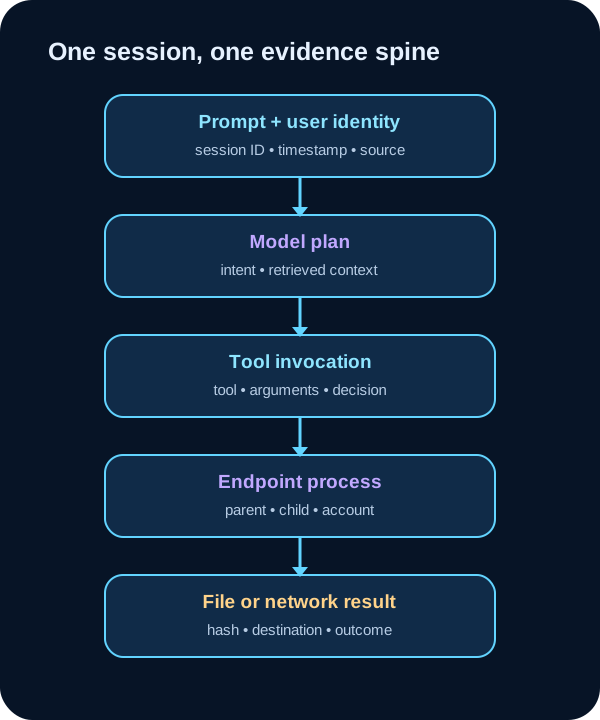
- Problem: an approved prompt can lead to an unapproved process or destination several tool calls later.
- Audience: SOC analysts, incident responders, endpoint engineers and teams operating coding or administrative agents.
- Output: one cited timeline, a side-effect inventory, explicit evidence gaps and a human disposition.
Start with telemetry you can actually join
Assign a session ID at the agent gateway and propagate it where supported. Record the initiating identity, model and policy version, retrieved context references, tool name, a redacted arguments hash, approval decision and result. On the endpoint, retain process start events, parent-child lineage, user or service account, signer, file hashes and network destinations.
Do not send raw prompts, secrets, private source code or customer records to a second model merely to make correlation easier. Build a redacted working set, preserve the originals in the authorized evidence store and keep stable pointers back to source records.
If a framework cannot propagate a session ID, correlate with a bounded time window, host, invoking identity and tool process. Mark that match as inferred. Clock synchronization and a known service-account owner are prerequisites, not cleanup tasks.

- Required join keys: session or trace ID, timestamp, actor and host.
- Independent proof: endpoint, network or cloud audit record for every claimed side effect.
- Evidence hygiene: hash exported records and document redaction before AI review.
Assemble the minimum case packet
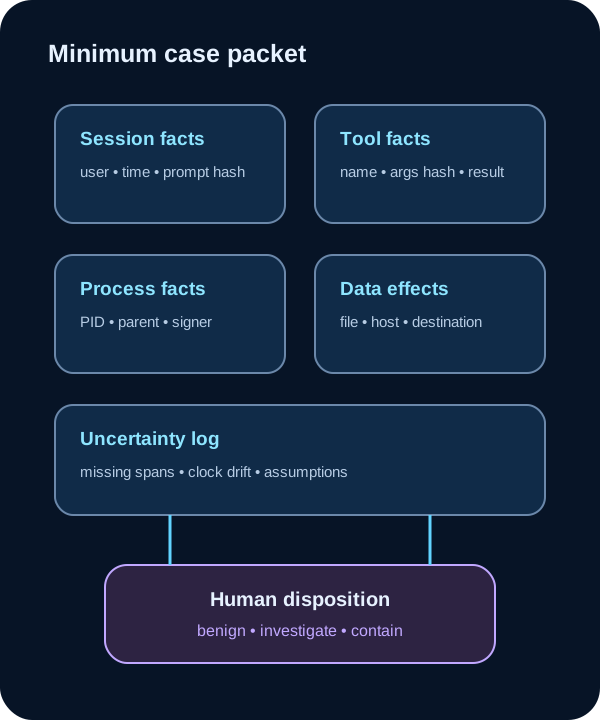
Create a case before asking an assistant to summarize it. The packet should contain session facts, tool facts, process facts, data effects and an uncertainty log. Each normalized event needs a source-system identifier and immutable pointer. A prose claim without a pointer is a lead, not evidence.
Separate observed facts from inferred links. For example, an endpoint record can prove that a shell process connected to an address; it cannot prove which model rationale caused the call unless the agent trace independently links the process and session.
Keep allowed behavior beside the evidence: approved task, repository or tenant scope, permitted tools, destination allowlist, and the user or service account's authority. That makes policy drift visible without guessing intent.
Run the investigation in six reproducible passes
First, freeze the session and endpoint window. Second, normalize the agent and host events. Third, join only on documented keys. Fourth, enumerate every file, process, network and cloud effect. Fifth, compare those effects with approved intent and authority. Sixth, have an analyst decide whether to monitor, investigate further or contain.
An approved assistant may help with the fourth and fifth passes. Give it the redacted packet and demand citations, contradiction reporting and a refusal to fill gaps. Never grant the summarizer live shell, endpoint-isolation, credential-reset or ticket-closing authority.
Example prompt: Review the supplied normalized events only. Produce a timestamped table with event ID, observed fact, source pointer and confidence. List proposed session-to-process joins separately, show the join keys, and mark every unsupported step unknown. Do not recommend or execute containment.

- Expected table: time, actor, action, target, result, source pointer and confidence.
- Expected appendix: effects by host, file, destination and cloud object.
- Required gap list: missing spans, ambiguous accounts, clock drift and redacted fields.
Make the decision ladder explicit
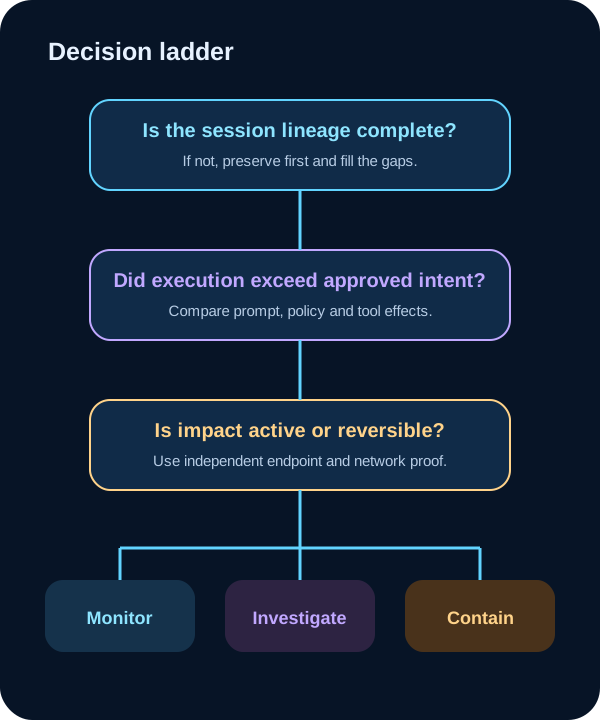
A complete lineage is not automatically malicious, and an alarming model explanation is not proof. If the lineage is incomplete, preserve first and fill gaps. If execution exceeded approved intent, investigate the mismatch. If independently verified impact is active, the incident commander can select a reversible containment action under the existing playbook.
Record who made the decision, which evidence supported it, what was deliberately not inferred, and how rollback will be validated. That audit trail is more defensible than a model-generated severity label.
What success looks like
A successful exercise produces a case another analyst can reproduce from source pointers. It identifies the initiating identity, approved task, tools invoked, process ancestry, data and network effects, unresolved gaps, and the named decision owner. It does not need to prove which model was used if the operational evidence is sufficient to manage risk.
Run the workflow against a benign scripted session first. Measure evidence completeness, join ambiguity and analyst time using your own environment; this article supplies no benchmark. Add detections only after the evidence spine survives that rehearsal.
Limitations and safe use
Agent hooks can miss subprocesses, remote execution, encrypted traffic or actions performed by another identity. Endpoint telemetry can also be incomplete, delayed or unavailable on managed services. Treat session graphs and threat scores as leads that require independent records.
CrowdStrike's supported-agent list and availability statement were current on October 30, but licensing, regional rollout and retention can change. Verify those details with the vendor. The vendor-neutral workflow still requires approved log access, privacy review, retention controls and an incident-response owner.
Put the insight into practice.
Deep Security helps organizations assess risk, validate controls, and build a practical plan to strengthen their defenses.
Talk with Deep Security