
Scope potentially exposed AI-agent logs, identify downstream secrets and data owners, and use approved AI only on sanitized evidence after a vendor incident.
Why agent telemetry belongs in the incident plan
BleepingComputer reported on October 27 that a third-party compromise in Warp's infrastructure exposed a limited amount of agent decision logs and user telemetry. The report attributed to Warp that roughly one percent of users were affected, that the activity was detected within hours and that plaintext credentials, source code and terminal command outputs were not exposed. Those are vendor-stated scope boundaries, not evidence about any particular customer's account.
A focused Firecrawl search on October 31 returned the BleepingComputer report and several recent follow-ups prominently. That is a current-attention signal, not proof of prevalence, impact, traffic or search ranking. The practical workload is to turn a vendor notification into a defensible record of what traces existed, what downstream secrets or regulated context may have appeared and which owners must act.
Do not paste the notice, raw traces or customer data into an unapproved public model. The assistant described here works only inside an authorized data boundary and only after evidence is preserved.
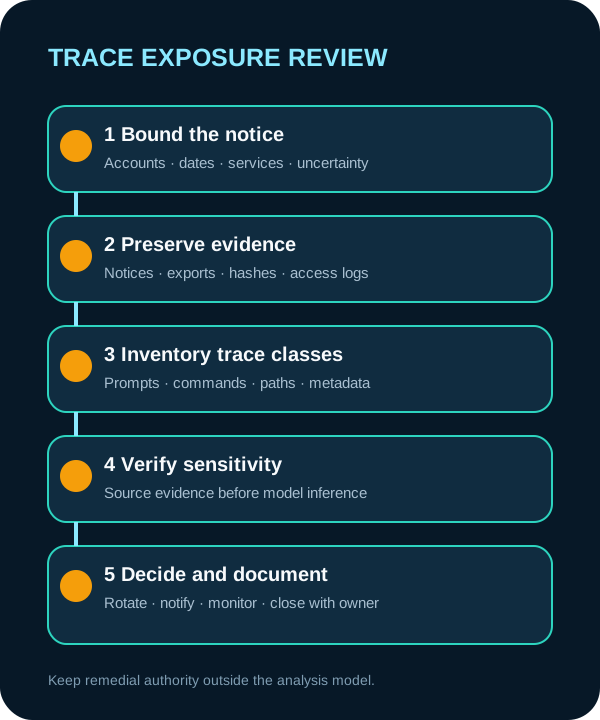
1. Bound the notice before inferring exposure
Record the affected organization, user identifiers, service tier, incident window, trace types, regions, retention state and any explicit exclusions. Preserve the original notice, support case, administrator export and relevant identity logs. Separate confirmed facts from vendor statements and unanswered questions.
Build an account-and-data-owner register. Include developers, security, privacy, procurement and any customer or regulated-data owner whose content could have entered prompts, paths, filenames or agent planning context. A one-percent platform figure does not determine whether your own workspace was affected.
The expected output is a bounded case worksheet with source links, timestamps, owners and unknowns. It is not a conclusion about breach impact.
- Preserve notices and exports before changing retention or access settings.
- Ask what decision-log fields existed, who could access them and when they were deleted or isolated.
- Record explicit exclusions separately from evidence you verified yourself.
2. Classify trace content with citations, not guesses
Create a sanitized sample that retains evidence identifiers while replacing live tokens, personal data and proprietary code with typed placeholders. An approved model can then group each trace by operational metadata, internal paths or code context, personal or customer data, and secrets or authentication material.
Example prompt: 'Using only sanitized trace set AT-31, return one row per trace with evidence ID, data class, cited field, possible downstream system, owner, confidence and unanswered question. Use unknown when the trace does not support a conclusion. Do not contact systems, rotate credentials, notify users or close the case.'
A reviewer should open the preserved source, verify every citation and look for indirect clues such as repository names, cloud account IDs, internal hostnames, ticket references and command arguments. Model confidence cannot replace source evidence.
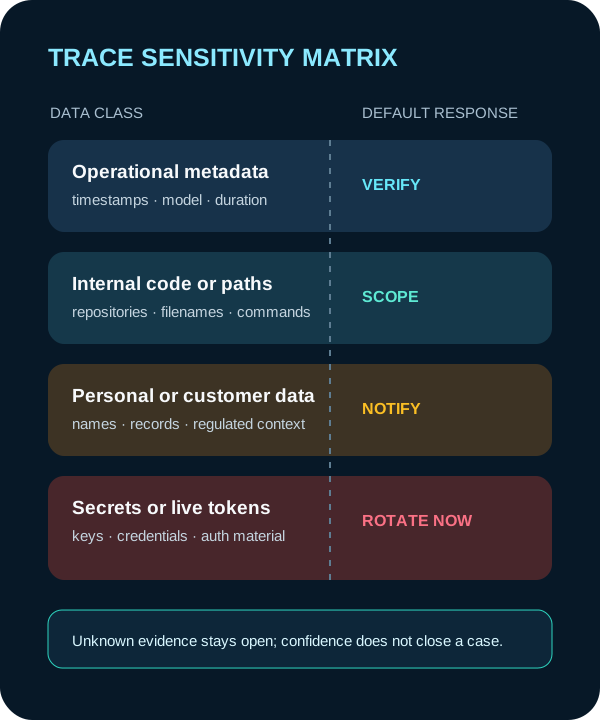
3. Rotate and notify from a human-owned decision queue
Prioritize live tokens, session material and credentials that the source evidence confirms were present or plausibly derivable. Rotate through the system of record, test that old access is rejected and preserve who approved the change. Broad emergency rotation without scope can cause outages and destroy evidence.
Route personal or customer data questions to the organization's privacy and legal process. Procurement should ask the vendor for the affected subprocessor, retention and deletion evidence, contractual notification timing, security-control changes and a stable incident reference.
DeepSecurity.io did not inspect Warp systems, affected traces or customer accounts. This workflow is a reproducible response pattern, not a finding that any reader was exposed.

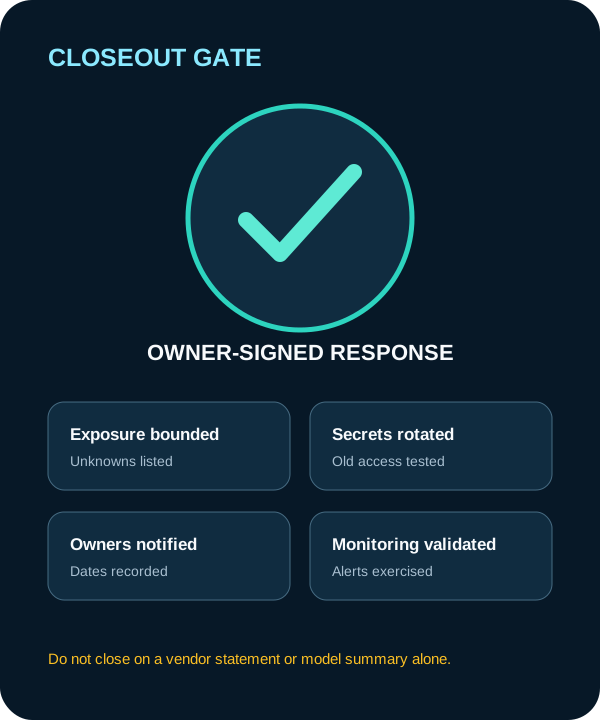
4. Close only after the evidence and controls agree
Re-run the trace inventory after rotation, verify alerting on old credentials, document data-owner decisions and record every unresolved question. If the vendor later changes scope, reopen affected rows instead of rewriting the original record.
Test the process with synthetic traces containing one benign task, one fake token, one internal path and one regulated-data marker. The assistant should cite the correct field and build a queue; it should not disclose, remediate or notify autonomously.
Close with an owner-signed statement of affected accounts, verified data classes, rotations, notifications, monitoring changes and residual uncertainty.
Put the insight into practice.
Deep Security helps organizations assess risk, validate controls, and build a practical plan to strengthen their defenses.
Talk with Deep Security