

What Kong Konnect AI Management adds and a step-by-step pilot for scoped agent credentials, MCP tool governance, cost controls and traceable AI traffic.
What changed on November 4
Kong announced AI Management in Kong Konnect on November 4, 2026. Kong says the feature brings AI cost controls, scoped credentials, MCP and tool governance, and observability into the Konnect control plane. The release is positioned for teams operating AI and agentic workloads through Kong AI Gateway rather than as a general-purpose model or autonomous agent.
The practical change is that a platform team can review who or what called a model, which tools were available, how traffic was routed, what it cost and which traces support the decision. Unite.AI published independent same-day coverage, providing a current-attention signal. The capabilities in this article remain vendor-described unless a step explicitly says to verify them in the tenant.
Availability, pricing and prerequisites
Kong says AI Management is included with Kong AI Gateway on Konnect and is not a separate SKU. Kong’s pricing page, checked November 9, lists a Plus plan at $25 per month plus usage, a 30-day Plus trial and custom annual Enterprise pricing. Exact metering, regions, entitlements and contractual terms can change, so confirm the current tenant and order form before planning a production rollout.
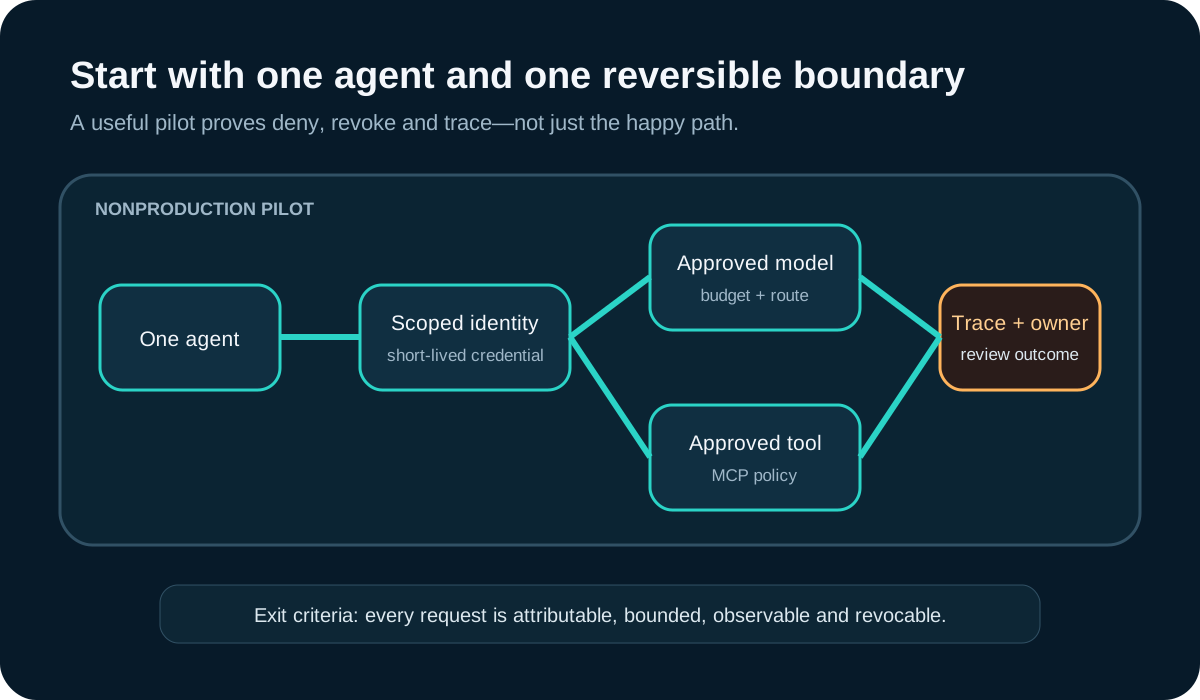
The intended audience is platform engineering, API security, FinOps and AI application owners already evaluating or using Konnect and AI Gateway. The pilot needs a nonproduction Konnect environment, one test agent, an approved model provider account, one low-risk read-only MCP tool, an identity owner, budget owner, observability destination and change record.

- Do not send customer or regulated data in the first pilot.
- Use a dedicated short-lived agent credential, not a developer’s personal key.
- Choose a reversible read-only tool and a fixed test budget.
- Record the exact plan, region and feature state observed in the tenant.
Step 1: build one joined entitlement record
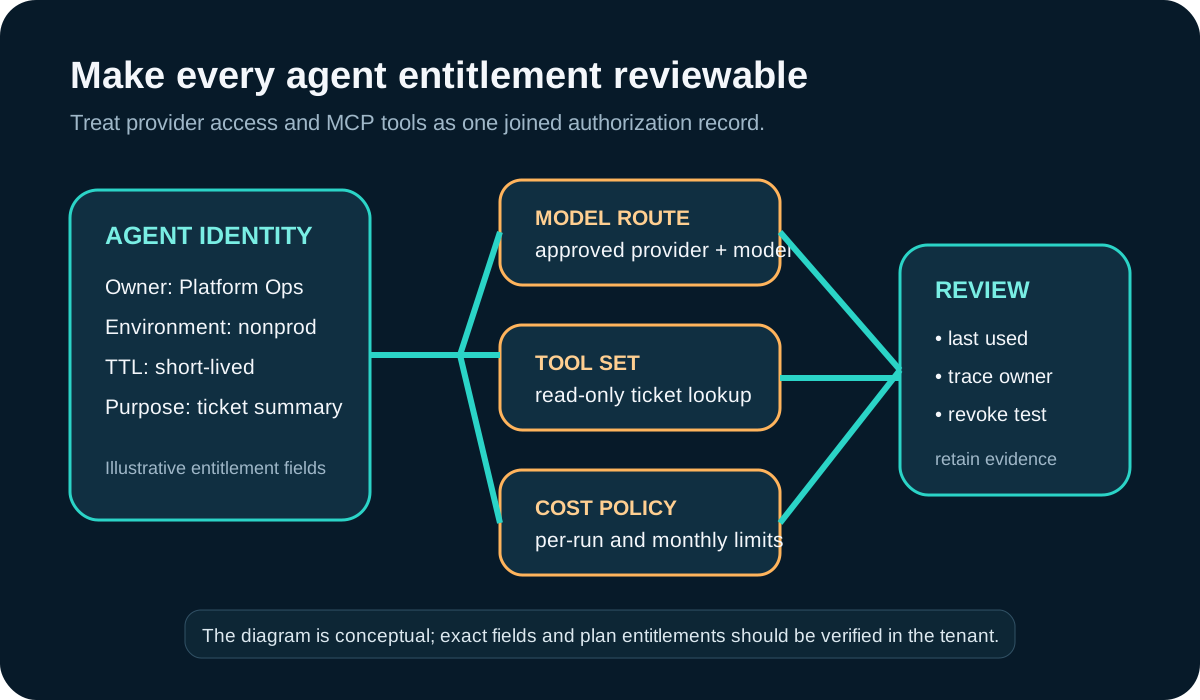
Inventory the pilot agent’s owner, environment, purpose, credential lifetime, approved provider and model, maximum request size, allowed MCP tools, budget limit, logging destination and revocation owner. Keep provider keys in the organization’s secret-management path and expose only the minimum route the agent needs.
Review model and tool entitlements together. A low-cost model route can still be high impact if the agent has a privileged tool, while a read-only tool can still leak data if the model route is not approved for that data class. Require an expiry and ticket for every exception.
Step 2: configure the smallest useful path
Route the test agent through the approved AI Gateway path, attach its scoped identity, allow one provider and model, register only the read-only test tool, and set a deliberately small test budget or token threshold. Send traces to the approved observability destination and confirm that identity, route, tool decision, cost and outcome can be joined.
Example implementation brief: “For AGENT-TEST-01, permit only MODEL-ROUTE-A and TOOL-READ-01 in nonproduction. Deny every other tool. Set the agreed test budget, emit an attributable trace for allow and deny decisions, and require a named human ticket for temporary exceptions. Do not enable production data or write-capable tools.” This is a control brief, not a command to paste blindly into a tenant.
Step 3: rehearse failure before success
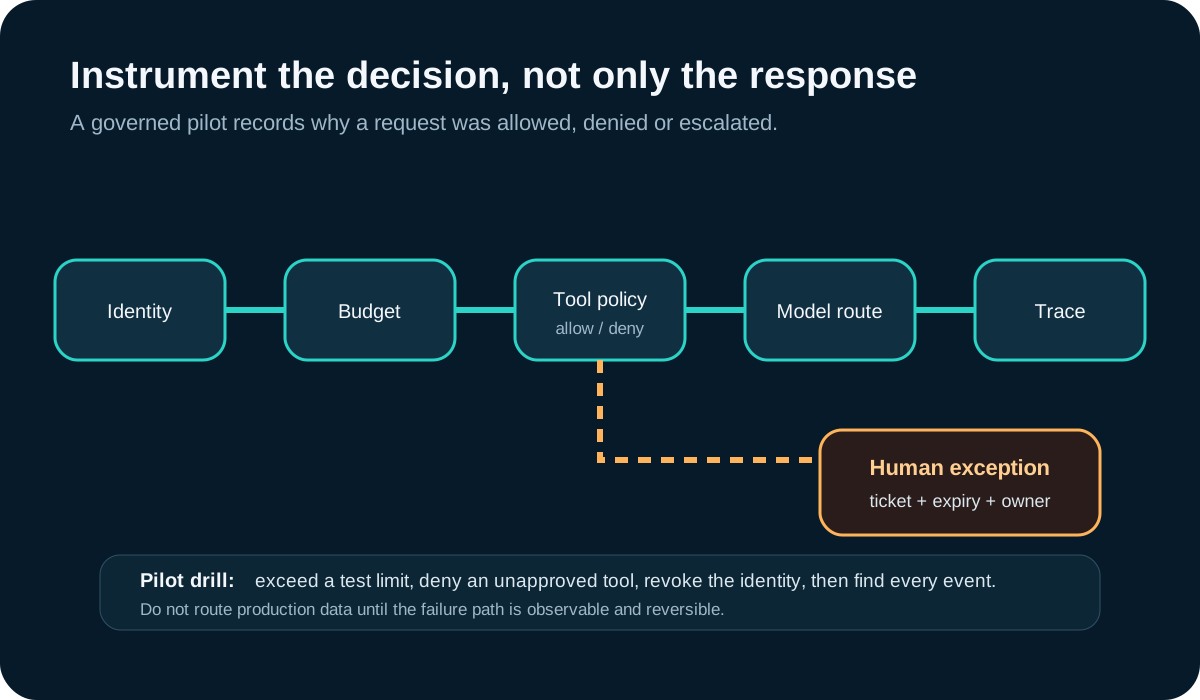
Run approved synthetic requests that exercise the normal route, an unapproved tool, a budget threshold and an expired or revoked credential. Confirm the expected request succeeds, the prohibited tool is denied, the limit creates the expected signal, and the revoked identity can no longer call the route. Locate each decision in the trace and ticket record.
Keep a human reviewer at the exception boundary. If the agent needs a broader tool or budget, require a time-limited approval with purpose, owner and expiry. A pilot that only demonstrates successful model responses has not tested governance.

Step 4: make the decision observable
For each test, retain the request ID, agent identity, policy decision, selected route, tool decision, cost fields, trace reference and human disposition. Reconcile gateway usage with the provider record and the approved budget. Investigate differences rather than assuming one source is authoritative for every field.
Define exit criteria before production: attributable requests, enforced model and tool boundaries, tested revocation, reviewable cost and a named incident owner. Add privacy, retention, regional and contractual review for the real data class before broadening the pilot.
Realistic limitations
A gateway sees traffic routed through it; direct provider calls, local models or tools outside the governed path can remain invisible. Cost fields may lag or differ from provider invoices, traces can contain sensitive prompt or tool data, and an allowed tool can still behave unexpectedly. Treat gateway governance as one control layer, not complete agent safety.
This article describes an illustrative rollout and was not tested in a live Konnect tenant. It does not assert performance, savings or security outcomes. Feature availability and interface details can vary by plan, region and release state, so validate the current documentation and tenant behavior before production use.
Why this topic was selected
A focused Firecrawl search on November 9 for “Kong Konnect AI Management November 4 2026 cost credentials MCP observability” returned Kong’s November 4 release first, its current pricing page and independent same-day coverage from Unite.AI. The announcement maps directly to a practical workload—governing agent credentials, tools, spend and traces—rather than generic AI news. Search placement is a freshness signal, not proof of popularity, rankings or traffic.
Put the insight into practice.
Deep Security helps organizations assess risk, validate controls, and build a practical plan to strengthen their defenses.
Talk with Deep Security