

Pilot Google Cloud IAM Helper Agent Skills for 403 diagnosis, policy simulation and just-in-time access while keeping policy approval human-controlled.
What Google Cloud introduced on October 27
Google Cloud introduced IAM Helper, a set of Agent Skills and MCP tools for end-to-end IAM workflows. The published skills cover policy authoring, 403 troubleshooting, policy simulation and Privileged Access Manager requests. Google says they work with Gemini CLI, Gemini Cloud Assist, ADK, Claude Code and Cursor.
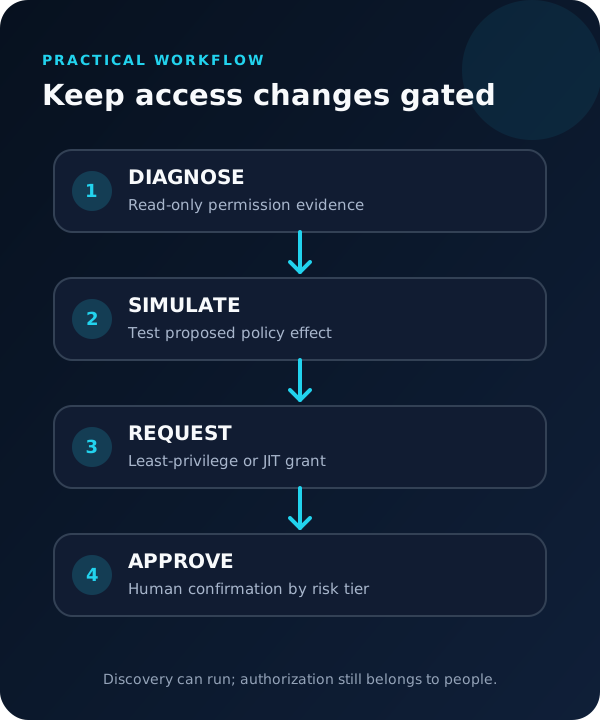
The design separates read-only diagnostics and simulation from changes. Google says an access-policy change pauses for human confirmation based on customizable risk tiers, while Google-managed MCP servers expose atomic read-only functions across Policy Troubleshooter, Policy Analyzer, Policy Simulator and IAM APIs. Teams can start from the public Google Cloud Agent Skills catalog.
A focused Firecrawl search on October 28 returned the Google Cloud announcement plus October 26-27 coverage from Techseen, OneBench and The GPU AI. That is current public-attention evidence, not proof of security, adoption, time savings, search traffic or ranking. The public pages do not provide one bundled price; required Google Cloud services, logs, APIs, quotas and support terms should be checked for the target project.
1. Pilot one known permission failure
Choose a nonproduction 403 error with a known cause and approved resolution. Record the principal, resource, attempted action, organization hierarchy, expected missing permission, applicable deny policies and the owner who previously resolved it. Do not begin with a production-wide agent or a mystery incident.
Install or pin the reviewed skill version in a controlled repository and use a dedicated test identity. Inspect the skill instructions, scripts and tool endpoints before execution. Limit the agent to the target project and read-only diagnostic operations; keep policy-writing credentials unavailable.
Ask the helper to return the effective allow and deny evidence, hierarchy location, missing permission, contradictory policies, and a structured ticket if the caller lacks authority. The answer should cite Google Cloud IAM results rather than asking the language model to reason over a pasted policy dump.

- Use a known 403 case with an approved expected answer.
- Pin and review the skill before connecting it.
- Start with a read-only identity in one nonproduction project.
2. Trace the effective hierarchy, not just the resource
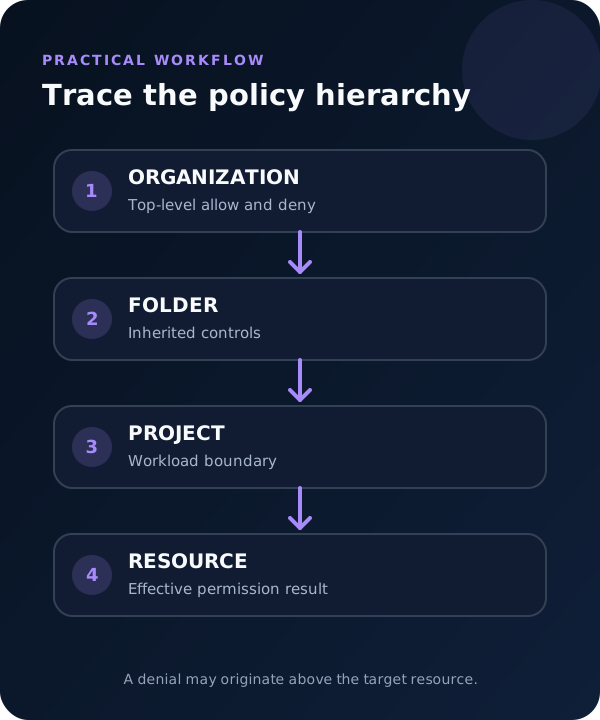
A project-level allow can still be blocked by an inherited deny, principal boundary or organization policy. Require the diagnostic result to show which organization, folder, project and resource policies were evaluated, which group or service-account memberships were expanded and which facts remain unavailable.
Example prompt: 'Diagnose this PERMISSION_DENIED result using read-only IAM Helper tools. Return the evaluated principal, resource, permission, inherited allow and deny policies, group expansion, and the first policy that determines the result. Cite the backend response for every conclusion. Do not request or change access.'
Verify the result in Policy Troubleshooter or the relevant IAM console/API. If the tool cannot inspect a boundary or group, record the case as incomplete. A concise explanation that omits the controlling policy is not ready for remediation.
3. Simulate the proposed policy before approval
Google describes a plan, simulate, analyze and apply flow that can test proposed changes against 90 days of historical access logs. Treat that window as evidence of observed past use, not a guarantee of future safety. New workloads, seasonal jobs and unlogged paths can fall outside the sample.
Generate the narrowest proposed binding or deny-rule correction and run the simulator without applying it. Return affected principals and resources, preserved and lost access, missing log coverage and any uncertainty. Compare the output with a hand-built expected result for the pilot case.
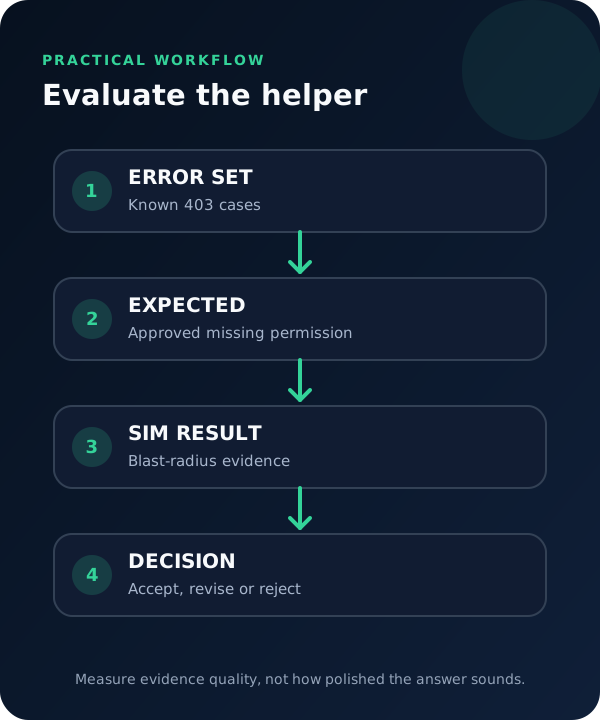
Use a regression set of known 403 errors, inherited denies, public-access attempts, basic-role requests and reductions that should break a test workload. Measure correct diagnosis, missing context, overbroad proposals, simulation mismatches and reviewer corrections.
4. Route every policy change through an accountable gate
The skill may prepare IAM allow or deny policy changes, but a cloud administrator should review the exact diff, affected hierarchy, simulation result, business justification, expiry and rollback. Use separate identities for requesting and approving where the risk tier requires separation of duties.
Block public principals and broad basic roles through organization policy and policy-as-code checks rather than prompt instructions alone. Require CI validation for Terraform or other infrastructure code, and keep the production apply credential in the established deployment system.
A human-in-the-loop pause is useful only if the reviewer receives enough evidence to make a real decision. Do not turn approval into a button that hides the effective policy, blast radius or unresolved warnings.

5. Prefer just-in-time access to standing privilege
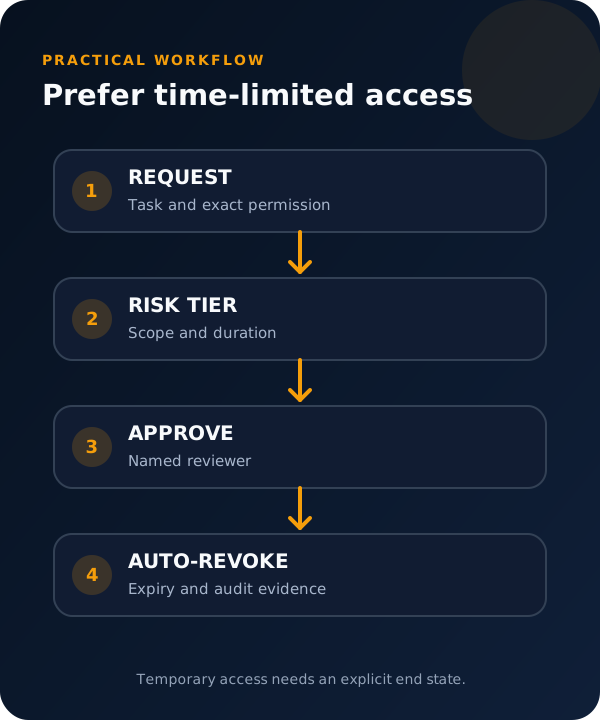
For a bounded maintenance task, have the helper prepare a Privileged Access Manager request with the exact permission set, resource, reason, duration and approver. The requester should not be able to approve the same grant. Verify that expiry removes access and that the audit record identifies every participant.
Test early revocation, denied approval, expired requests and a task that exceeds its approved duration. Confirm that the workload fails safely when access is removed and that the agent cannot silently obtain a broader role to continue.
Do not assume temporary means low risk. A short-lived owner role can still cause irreversible damage. Use the smallest custom role or predefined permission set that completes the task, then verify both the task outcome and the revocation.
6. Decide whether the feature improves the actual workload
Track diagnostic accuracy, cited-policy completeness, simulation differences, reviewer time, overbroad proposals, denied requests, revocation success and skill or API failures. Do not use token efficiency or a polished explanation as a substitute for correct effective-access evidence.
Set stop conditions for unsupported policy claims, missing hierarchy context, a requested change without human confirmation, public or broad-role proposals, unlogged privileged access or failed revocation. Remove the skill and connected identity if the boundary does not hold.
DeepSecurity.io did not run IAM Helper against a Google Cloud organization. Capabilities in this guide are based on Google's announcement and public catalog, while outcomes remain illustrative. The expected pilot result is a reproducible 403 diagnosis, simulation record and governed access decision.
Put the insight into practice.
Deep Security helps organizations assess risk, validate controls, and build a practical plan to strengthen their defenses.
Talk with Deep Security