

Test CrowdStrike Falcon Guardian's new AI Kill Switch with a scoped agent, two-person approval, evidence capture and a controlled recovery path.
What CrowdStrike released on November 3
CrowdStrike announced AI Kill Switch in Falcon Guardian on November 3, 2026. Its technical blog says an authorized security team can direct connected AI gateways to block the AI-model access that powers an agent's decisions and actions. The gateway can be CrowdStrike's newly generally available Falcon AI Gateway or a connected third-party gateway.
CNBC covered the launch the same day and clarified a crucial boundary: the control does not delete an agent's code. It cuts model access, requires a human decision and can later restore access. That independent coverage and multiple fresh search results establish current public attention, not adoption, traffic or proven effectiveness.
CrowdStrike describes broader endpoint, cloud, identity, SaaS and browser containment as coming soon. Its own demo disclaimer says unreleased functionality remains in development and subject to change. A defensible pilot therefore evaluates today's gateway enforcement without presenting roadmap features as available controls.
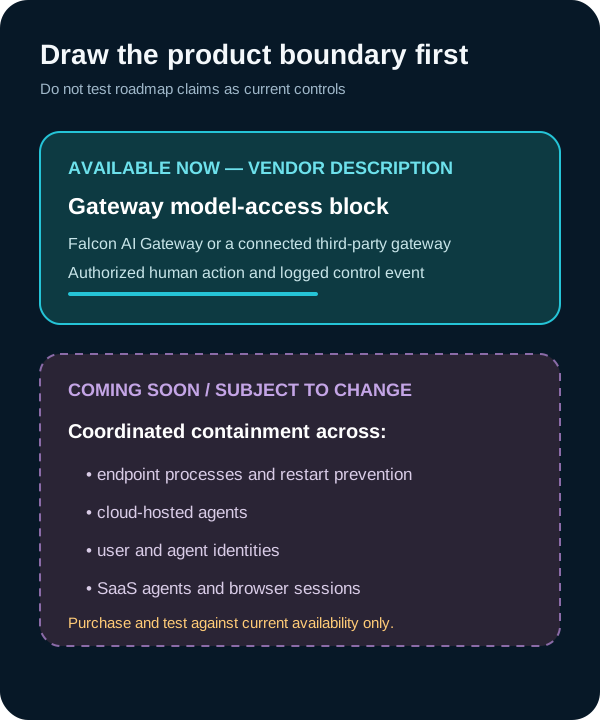
- Available now: AI Kill Switch in Falcon Guardian, with Falcon AI Gateway included at no additional cost according to CrowdStrike.
- Current practical action: block an agent's access to AI models through a connected gateway.
- Not established here: independent efficacy, universal process termination or complete containment across every agent tool and environment.
Choose one agent and map every path it can still use
Start with a nonproduction agent whose owner, model endpoints, credentials, tools and network destinations are known. Route its model calls through the selected connected gateway and record the expected request path. Keep a separate observer outside the agent's control plane so the drill can verify behavior rather than trusting the product label alone.
Inventory fallback models, cached responses, queued jobs, direct API credentials, local tools, browser sessions, service accounts and child processes. Blocking model access may stop new reasoning while leaving previously queued actions or non-model tools available. Remove production-write authority from the drill identity and use synthetic data.
Define a named business owner, security operator and recovery approver. Document which Falcon Guardian and gateway entitlements are present and confirm current pricing with CrowdStrike; public materials reviewed for this article did not provide a standalone list price for Falcon Guardian.
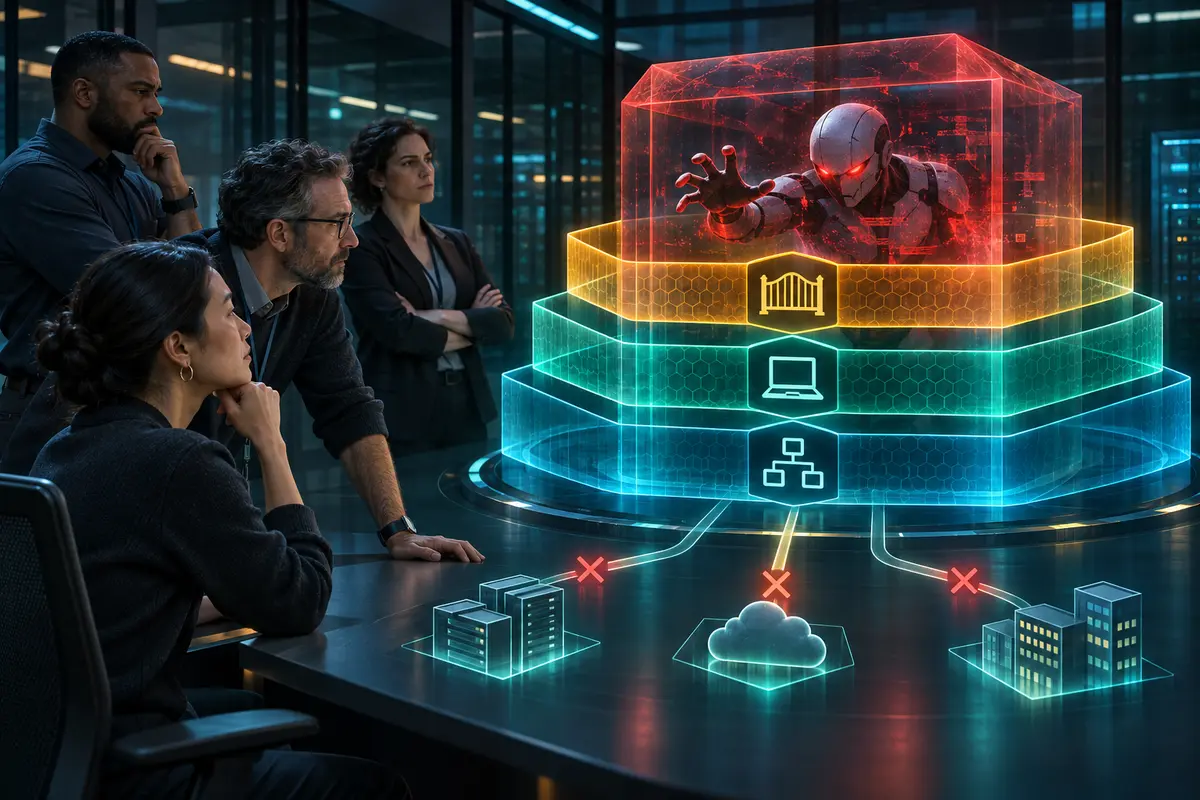
- One nonproduction agent and one connected gateway path.
- Synthetic credentials, data and destinations with no customer or production impact.
- Independent network, process and audit telemetry retained outside the agent workspace.
Write a two-key activation and recovery runbook
Create triggers that a responder can verify: an agent reaches an unauthorized destination, attempts a prohibited tool, exceeds a spending or action threshold, or diverges from its assigned task. Separate the person who declares the trigger from the authorized administrator who activates the control. For a severe live incident your emergency policy may permit one operator, but the exception and after-action review should be explicit.
Example decision prompt for the incident assistant: “Using only the supplied event IDs, summarize the agent's last ten actions, identify the policy trigger, list affected identities and destinations, and state what evidence is missing. Do not activate a control, restore access, revoke credentials or claim containment. Return source IDs for every fact.”
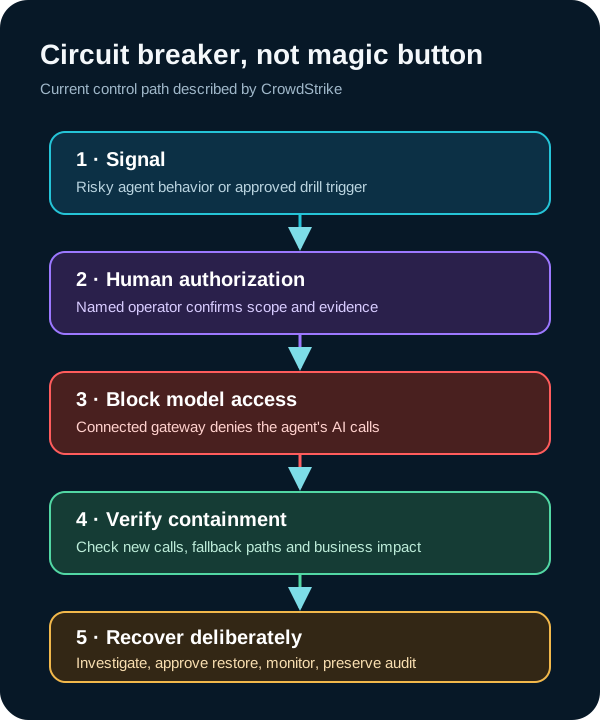
The expected output is a cited decision packet, not an automated verdict. The human operator confirms scope, records the reason and activates the kill switch. A separate approver owns recovery after the cause, residual access and downstream impact have been reviewed.
Run a reversible drill and verify from outside the product
Seed a harmless but unambiguous policy violation, such as a request to a synthetic forbidden endpoint. Capture the detection time, operator decision, activation event and first confirmed blocked model call. Then check whether the agent retries, changes providers, continues queued work, invokes a non-model tool or restarts under another identity.
Keep the simulated task reversible. Do not use destructive commands, real secrets or production systems. If the drill agent can bypass the gateway through a direct credential, stop the exercise and repair the architecture rather than expanding the product's permissions to hide the gap.
Restore access only after the recovery approver confirms the agent version, credentials, routing, outstanding jobs and monitoring state. Record who restored access, why, and which observation proves normal operation without repeating the violation.

Score containment, evidence quality and recovery
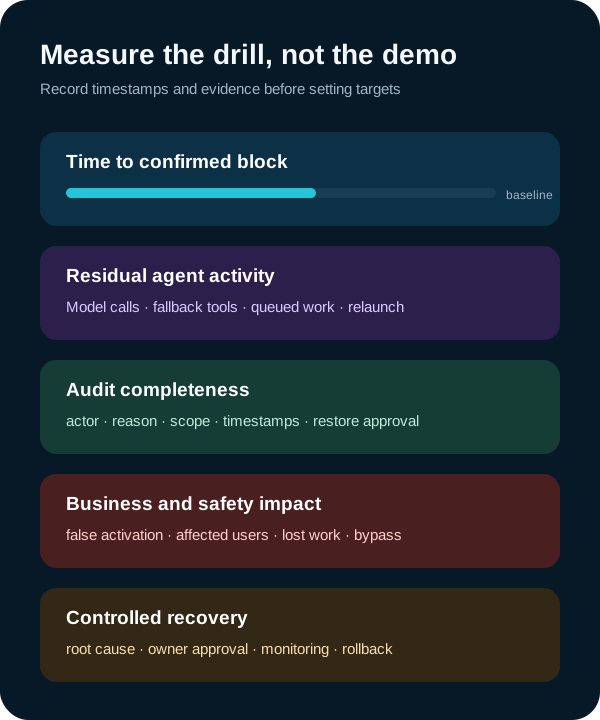
Measure time from verified trigger to activation, time to the first confirmed blocked call, residual actions after activation, bypass attempts, audit completeness, false activations, business impact and time to controlled recovery. Establish your own baseline before setting thresholds; vendor wording is not a benchmark.
Repeat the drill with a second model route, a queued action, a disconnected gateway and an unavailable approver. The control should fail visibly, and responders should still have a manual path to revoke credentials, isolate the host or disable the service according to existing incident procedures.
Promote the control only for agent classes whose routes and owners are known. A kill switch cannot compensate for untracked agents, shared credentials, missing logs or an emergency process nobody rehearses.
Limits to keep visible
Gateway enforcement depends on traffic actually traversing a connected gateway. Local models, cached outputs, direct credentials, non-model tools and already-running actions may require separate controls. A blocked model call is evidence about one path, not proof that the entire agent is inert.
CrowdStrike's broader coordinated containment is described as coming soon. Availability can vary by entitlement, integration and environment, and the reviewed public pages do not publish a standalone Guardian price. Confirm contract scope and test the exact deployment before relying on it for an emergency control.
Keep ordinary endpoint isolation, identity revocation, network containment, incident command and recovery procedures. The value of this feature is a faster human-controlled interruption point—not permission to deploy agents without least privilege, inventory, monitoring and rollback.
Put the insight into practice.
Deep Security helps organizations assess risk, validate controls, and build a practical plan to strengthen their defenses.
Talk with Deep Security