

Evaluate AI security review across pull requests, shared libraries and linked repositories with bounded access, sandbox verification and human merge gates.
Why security review has to extend beyond one pull request
OpenAI described on October 26 how CodeRabbit uses GPT-6.1 Sol as the primary model in its security agent. The reported workflow examines pull requests, performs broader Deep Scans and can connect linked repositories such as a shared authentication library. CodeRabbit says the product complements established scanners and uses other models and security tooling as well.
That matters because a locally safe-looking change can weaken an invariant elsewhere: a helper may remove an authorization check, a shared parser may change taint handling or a service contract may make a previously unreachable function exploitable. The useful pattern is not ‘ask a model if code is secure’; it is ‘trace a specific security hypothesis across real call paths and dependencies.’
Firecrawl’s October 27 focused search returned OpenAI’s dated customer story and current independent analysis among the leading results. The independent coverage identified a time-limited CodeRabbit offer and several caveats. This is evidence of current attention, not proof of model accuracy, product performance, search traffic or ranking.
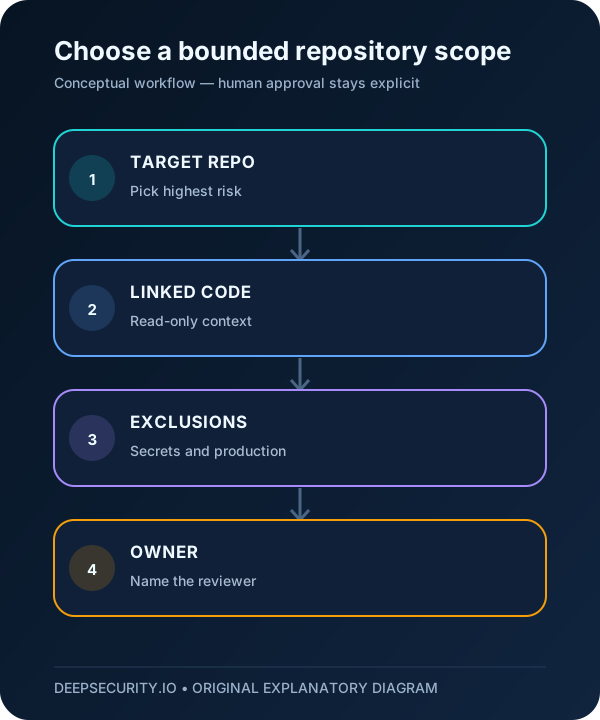
1. Start with the repository you most need to understand
Choose a high-value repository with a known owner, threat model and test suite. Inventory the linked libraries, services, generated code and infrastructure definitions needed to evaluate its security behavior. Exclude secrets, production credentials, customer data and unrelated repositories.
Use a read-only integration and a dedicated test branch. Confirm what the tool retains, which model providers receive code, where processing occurs and how access is revoked. If legal or data-governance requirements do not permit the code to leave your approved boundary, stop before connecting it.
CodeRabbit’s public security page advertised free Deep Scans through November 8, 2026. Independent coverage reported a ceiling of up to $5,000 per organization and eligibility for organizations with at least two members. Those promotional terms can change; verify the current offer and paid pricing directly before relying on them.

- Document exactly which repositories are in scope.
- Use read-only access and revoke it after the evaluation.
- Treat the offer as a pilot budget, not proof of suitability.
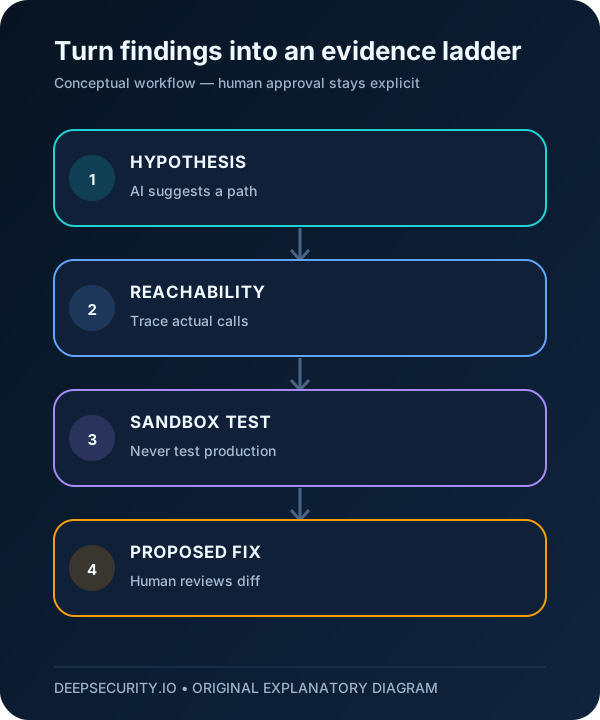
2. Turn findings into an evidence ladder
For every finding, require the file and line, the changed behavior, the source of untrusted input, the sensitive sink, the path between them, the violated security property and the assumptions that make exploitation possible. A severity label without that chain is not ready for triage.
Separate four states: plausible hypothesis, reachable path, reproduced in an isolated environment and confirmed fix. Do not collapse ‘inconclusive’ into false or safe. A finding can be plausible but unverified because a dependency, configuration or test harness is missing.
Example prompt for a defensive review: ‘Using only these approved repositories, trace whether this change can bypass the existing authorization boundary. Cite every file and symbol in the path. List required runtime conditions and contradicting safeguards. Return a minimal sandbox test plan. Do not attempt production access, create persistence or claim exploitability without reproduction.’
3. Verify safely and keep independent controls
OpenAI says CodeRabbit can attempt user-selected exploit verification in an isolated sandbox and draft a fix for supported issues. Keep that boundary strict: no production targets, no real credentials, no uncontrolled egress and no destructive payloads. Log the test image, inputs, result and teardown.
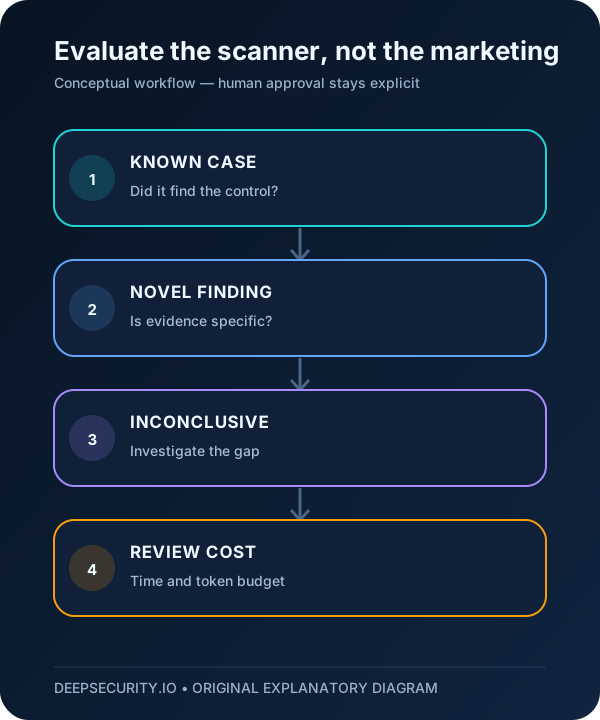
Continue running established SAST, dependency, secret and policy scanners. Cross-repository reasoning may add context, but it does not replace deterministic coverage or specialist review. Compare overlap, unique findings and missed known cases instead of asking which tool ‘wins.’
A useful pilot includes at least one previously fixed issue as a control. If the tool cannot identify or explain that known path, investigate why. If it returns a wall of inconclusive findings, measure reviewer effort before expanding scope.
4. Review the proposed patch as a new security change
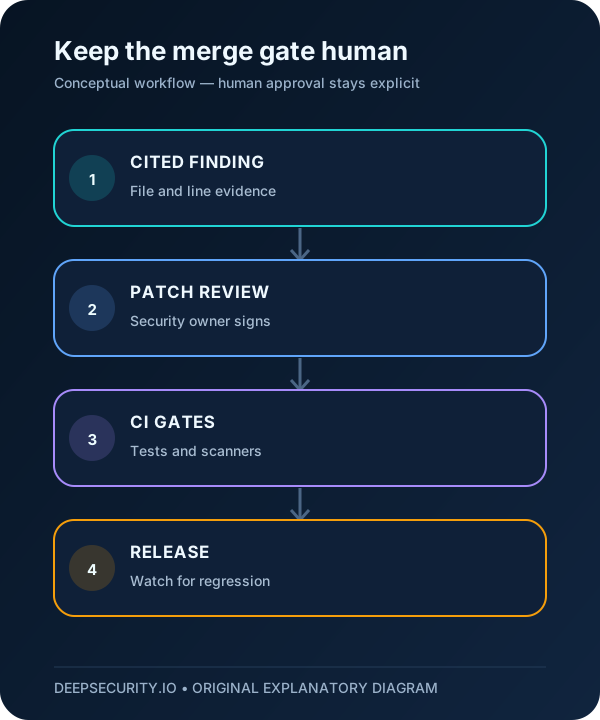
A generated patch can fix the symptom while creating a new authorization, availability or compatibility defect. Require the security owner and code owner to review the diff, add regression tests and run the normal CI, dependency and policy gates.
Prefer small changes that restore an explicit invariant. Verify the patch in the same isolated case that reproduced the issue, then test adjacent callers and failure modes. Never auto-merge because the same model both found and fixed the problem.
DeepSecurity.io did not run CodeRabbit Secure or reproduce OpenAI’s customer story. Vendor-reported adoption or vulnerability counts are not independent benchmarks, and this article does not treat them as measured outcomes.

5. Make the pilot produce a reusable decision
Record true positives, false positives, inconclusive findings, duplicate scanner results, novel evidence, review time, sandbox failures, suggested-patch acceptance and regressions. A rejected suggestion is not automatically a false positive; capture the reviewer’s reason.
Set promotion criteria before the scan: for example, no unresolved critical findings, reproducible evidence for high-severity claims, acceptable review burden and a tested revocation path. Also set a rollback condition for excessive noise, missing provenance or unauthorized repository access.
The closeout packet should contain scope, permissions, model and product versions, findings with evidence states, comparison to existing controls, patch decisions, residual risk and the named person who decides whether the tool remains connected.
Put the insight into practice.
Deep Security helps organizations assess risk, validate controls, and build a practical plan to strengthen their defenses.
Talk with Deep Security