

A practical, evidence-linked workflow for using an approved AI assistant to normalize historical client records while analysts retain reconciliation and approval.
Why this onboarding workflow is timely
Northern Trust and Microsoft announced on November 9 that an AI-powered agent is deployed in Northern Trust Asset Servicing’s Front Office Solutions onboarding process. The stated workload is unusually concrete: transform years of historical transaction data into Northern Trust’s standard format before a client goes live, while analysts review the output, evaluate reasoning, resolve exceptions and approve the result.
Microsoft reports that Northern Trust measured an 83% reduction in preparation time across production onboarding cases, from a prior baseline of about two and a half weeks to an average of three days. It also reports a 96.5% first-pass F1 score across seven representative, anonymized historical workbooks. These are company-reported measurements with a narrow test design; they are not Deep Security testing, an industry benchmark or a promise that another organization will see similar results. CIO and FinTech Futures covered the deployment on November 9 and 10, providing current-attention signals beyond the vendor announcement.
Audience, tools and data boundary
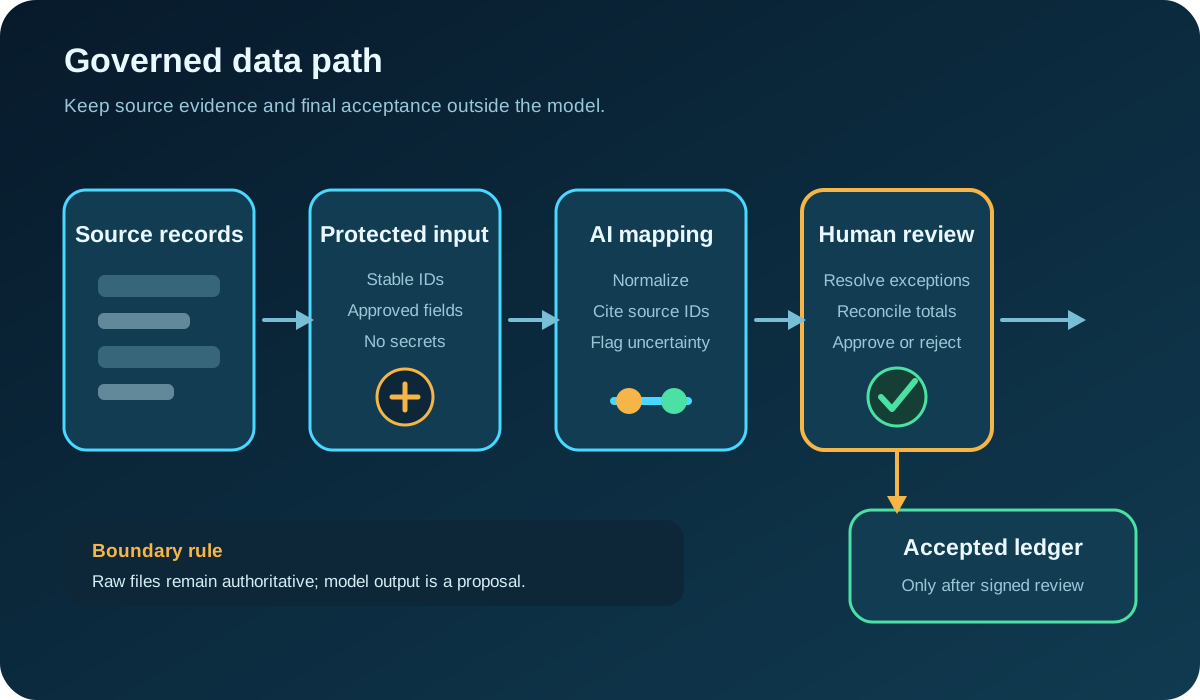
This pattern fits operations teams, data migration leads, security and privacy reviewers, and analysts onboarding a customer, supplier or acquired business. You need authoritative source files, a documented target schema, deterministic validation rules, a controlled exception queue, and an organization-approved AI service with appropriate retention, residency and training controls. Northern Trust’s implementation uses Azure, Microsoft Foundry, Excel and SharePoint, but the control pattern is provider-neutral.
Do not send raw identifiers, account numbers, credentials, signatures or unrestricted workbooks to a general-purpose model. Create a controlled workspace, assign stable record and field IDs, tokenize sensitive values where possible, and give the assistant only approved columns plus the mapping rules it needs. Keep original files immutable and access-logged.

- System of record: original exports, approved schema and signed reconciliation evidence.
- AI role: propose mappings, normalize allowed values, explain uncertainty and draft exception rows.
- Human role: resolve ambiguity, approve rules, accept the ledger and authorize go-live.
- Stop condition: missing lineage, an unreconciled control total or a request for secret material.
Step 1: define the mapping contract before prompting
Build a data dictionary with source field ID, target field ID, type, allowed values, required transformations, precision, date and time-zone rules, null handling, and the owner of each definition. Add control totals for row counts, balances, currencies, effective dates and entity relationships. A model should not invent these business rules from examples.
Create a small evaluation set that includes valid records, missing values, duplicate transactions, inconsistent dates, merged entities, unusual currencies and deliberately ambiguous descriptions. Hold the analyst-approved answers back from the assistant. This gives the team a repeatable way to assess mapping quality and exception behavior before using live onboarding files.
Step 2: ask for a row-level proposal with evidence
Process a bounded batch and require structured output. Each proposed target value should carry the source record ID, source field ID, transformation rule ID, confidence label, contradiction field and next human check. Unknown must be an allowed result. Do not ask the assistant to write directly to the accepted ledger.
Example prompt: “Using only mapping-contract version MC-12 and the attached tokenized rows, return one proposed target row per source record. For every target value include source record ID, source field ID, rule ID and any contradiction. Put ambiguous or missing mappings in an exception array with the exact question an analyst must answer. Do not infer customer identity, invent values, call tools or mark a record accepted. Return unknown when the contract does not support a mapping.”
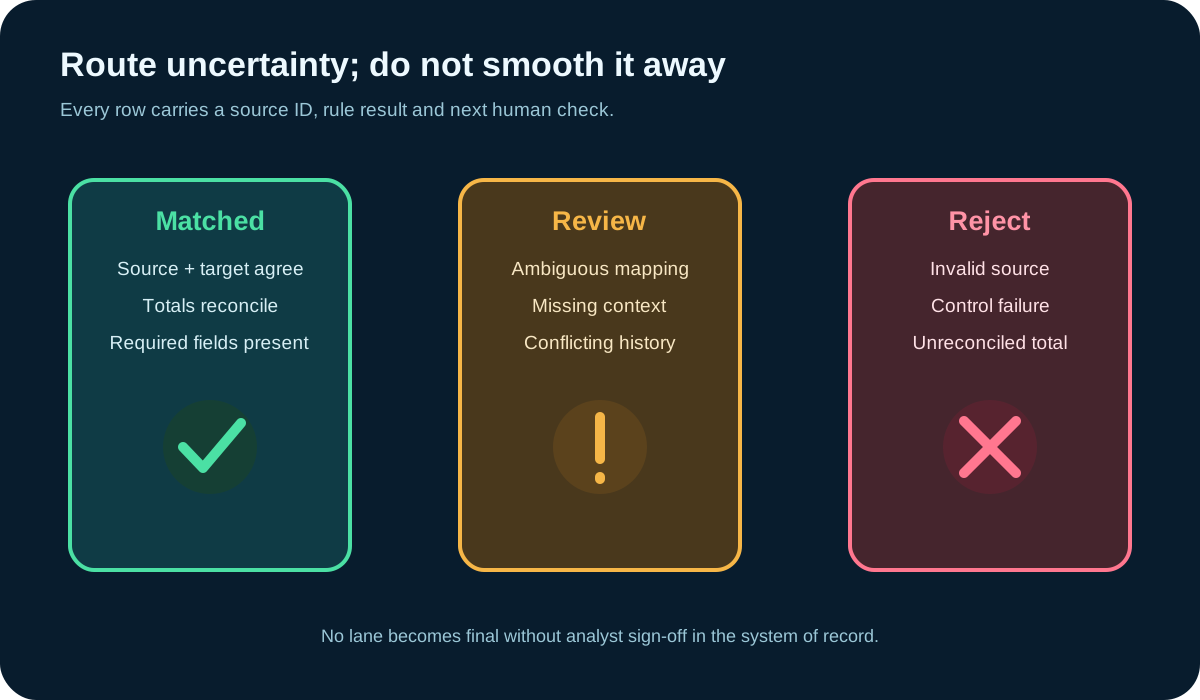
- Expected output: a machine-readable proposed ledger plus a separate exception queue.
- Reject any value without a source and rule reference.
- Re-run deterministic type, range and referential-integrity checks after generation.
- Measure false acceptance of bad rows, not only overall match rate.
Step 3: reconcile, sample and approve
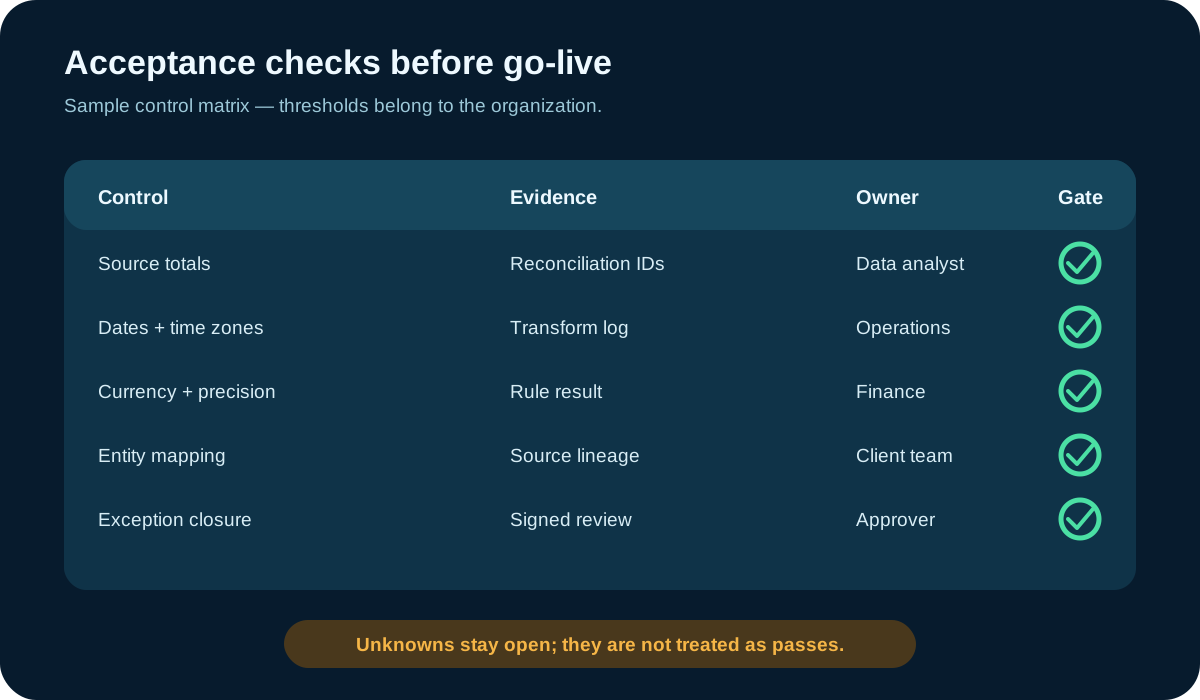
Run deterministic reconciliation against the preserved source: row counts, totals by currency and entity, date ranges, duplicate counts and referential links. Sample high-confidence rows as well as every exception, because confident mistakes are operationally dangerous. Require a second reviewer for material totals, schema changes and exceptions that affect downstream reporting.
A named approver should accept or reject the batch in the authoritative workflow. Record the mapping-contract version, model and configuration label, input batch hash, validation results, reviewer, exception dispositions and final ledger hash. If the contract changes, invalidate affected approvals and re-run the relevant checks.

Step 4: verify the first live batch
Before go-live, compare the accepted ledger with independent source samples and downstream reports. Recalculate balances outside the AI workflow, verify date and currency conversions, and trace a random sample back to original files. Monitor correction rate, exception age, reviewer overrides and any downstream reconciliation breaks. Roll back to the preserved source and last approved ledger if a material control fails.
Northern Trust says its analysts review, refine and approve work in familiar Microsoft 365 tools and that Microsoft tuned evaluations using anonymized data while client data remained under Northern Trust governance. That is useful design evidence, but readers still need their own data-classification, residency, access-control, retention and vendor-risk decisions.
Realistic limitations
An AI assistant cannot repair missing source history, decide the correct business definition, prove a client record is authentic or replace financial and privacy controls. It may normalize a plausible but wrong value, merge similarly named entities, mishandle locale-specific dates, or hide an exception inside fluent prose. Quality metrics can also look strong on a small representative set while rare but material edge cases remain.
Treat the model as a mapping assistant inside a governed data process. The practical success measure is not how many rows it fills; it is whether reviewers can trace, challenge and safely reject every proposed transformation.
Why this topic was selected
A focused Firecrawl search on November 10 for “Northern Trust Microsoft AI client onboarding agent November 9 2026” returned the November 9 Microsoft announcement first, followed by same-day CIO coverage and additional FinTech Futures coverage published November 10. The coverage establishes a recent deployed workload and independent attention; it does not prove search volume, Google ranking or traffic to this article. The information gap was a reusable, provider-neutral reconciliation and evidence workflow for security-conscious operations teams.
Put the insight into practice.
Deep Security helps organizations assess risk, validate controls, and build a practical plan to strengthen their defenses.
Talk with Deep Security