

Turn redacted incident evidence into a cited breach-impact ledger that helps security, privacy and legal teams scope affected data while preserving human notification decisions.
Why breach impact—not just attack path—needs structure
Chainalysis said on October 30, in an incident update expanded November 2, that an external actor used “offensive agentic techniques” in a breach. The company reported no evidence that investigation content, authentication credentials or session tokens were accessed, while saying some user IDs, names, email addresses and organization role labels were accessed. It also said scope determination remained in progress.
SecurityWeek independently covered the disclosure and noted that the number of affected individuals had not been disclosed. Chainalysis said it took Reactor and Data Solutions offline on November 2 while some compliance monitoring stayed available, and that it was using large language models to support a broader platform security review. Those are company statements, not independent findings.
The operational lesson for incident responders is narrower: impact scoping changes as evidence arrives. A cited ledger can help security, privacy, legal and customer teams reconcile the same facts without letting a fluent narrative harden an early assumption.
- Problem: data-exposure claims are scattered across logs, tickets, exports and interviews.
- Audience: incident response, privacy, legal, customer operations and executive coordinators.
- Output: a row-level impact ledger with evidence pointers, confidence, owner and open question.
Build the ledger outside the model first
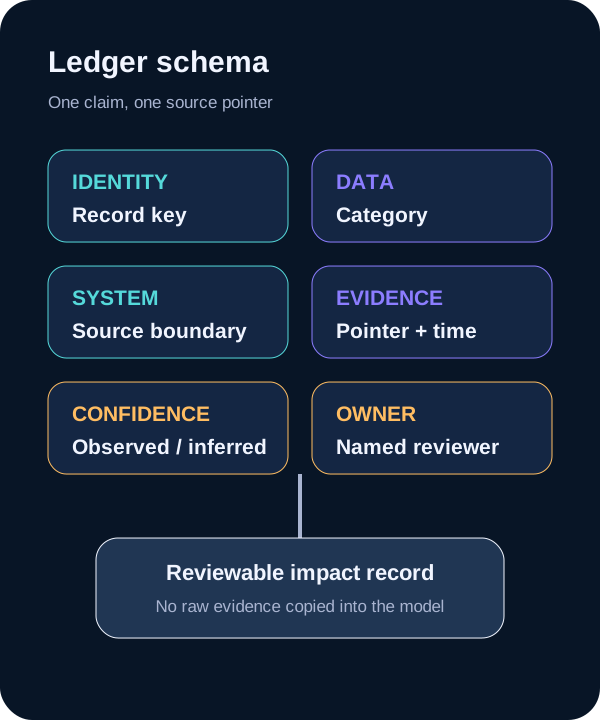
Create stable record IDs in the approved case platform. For each potentially affected identity or cohort, capture the data category, source system, time window, evidence pointer, observed or inferred status, reviewer, next action and jurisdictional or contractual owner. Store hashes for exported evidence.
Do not paste raw personal data, credentials, customer investigation content or privileged legal analysis into an unapproved assistant. Use tokenized identities, category labels and bounded excerpts. The model should receive enough structure to reconcile records, not a second uncontrolled copy of the breach.
Keep a data dictionary beside the ledger. Define terms such as accessed, exposed, exfiltrated, affected and notified so different teams do not use the same word for different evidentiary states.

- Minimum fields: record ID, identity token, data category, system, evidence pointer and time.
- Governance fields: confidence basis, reviewer, jurisdiction or contract owner, and due date.
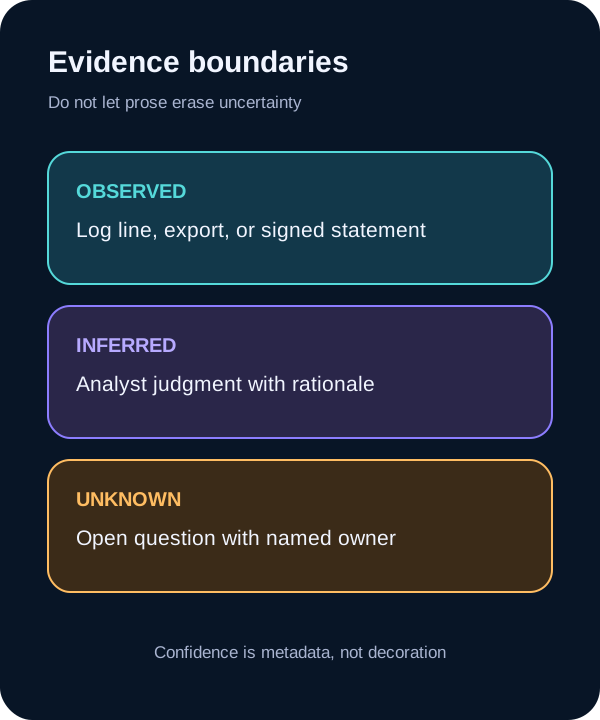
- Never infer “not affected” solely from an absent log; record visibility limits.
Use a constrained reconciliation prompt
Feed the assistant a redacted export with explicit field definitions and allowed status values. Instruct it to preserve record IDs, never merge identities without a deterministic key and never convert an unknown into a negative finding.
Example prompt: “Normalize these ledger rows using the supplied schema. For each statement, cite its record and evidence-pointer IDs. Mark it observed, inferred or unknown. Flag contradictions, duplicate identity tokens and missing review owners. Do not decide whether a legal breach occurred, whether notification is required or whether a person is affected when the evidence is inconclusive.”
Expected output is a proposed normalized table, contradiction list and missing-evidence queue. An analyst must compare every changed row with the source export before it returns to the case system.
Turn the ledger into accountable work queues
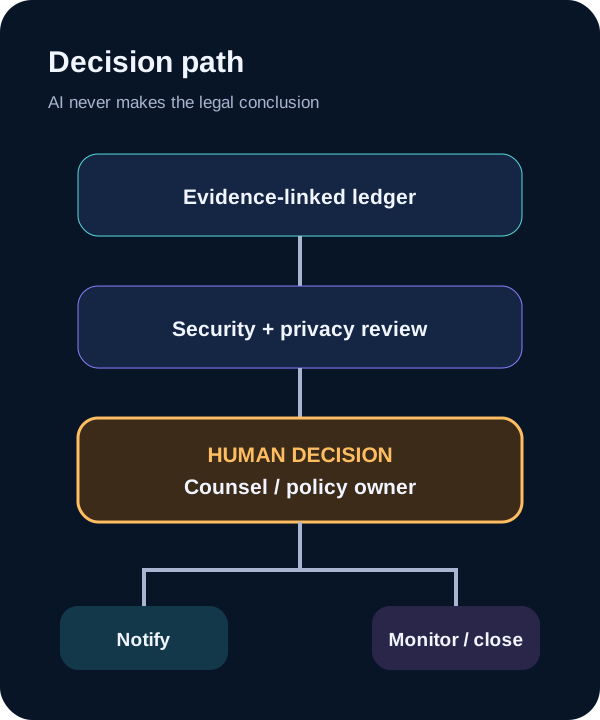
Route technical gaps to incident response, identity questions to the system owner, data-category questions to privacy, contractual questions to customer operations and notification analysis to counsel or the designated policy owner. One row can have several owners, but each open question needs exactly one next-action owner.
Use AI to group records by shared evidence source, affected system or missing field, then let teams work the queue. Do not let the assistant send notices, update customer status pages or close an impacted cohort.
Before a decision meeting, generate a one-page delta: what changed since the previous snapshot, which evidence supports the change, which cohorts remain unresolved and which deadlines are approaching. Preserve both snapshots.
Test with a synthetic mini-breach
Create synthetic rows for a confirmed email exposure, an identity with conflicting exports, an out-of-window record, a deleted log and a system with no visibility. Seed duplicate tokens and a missing owner. The assistant should surface those conditions without declaring the unresolved identities safe.
Measure citation completeness, unauthorized field changes, identity merges, contradiction recall and reviewer corrections. Record model, prompt and schema versions so a later result can be reproduced. Deep Security did not test this workflow on Chainalysis systems or customer data.
Promote the workflow only after privacy and legal owners approve the fields, the redaction process and the handoff. Model speed is irrelevant if the ledger cannot survive review.

Limitations and failure modes
An incomplete evidence source produces an incomplete ledger. Identity resolution can be wrong when names or email aliases change. A model may collapse two records, soften uncertainty or treat a company statement as independently verified fact.
Legal duties vary by jurisdiction, contract and facts. This workflow is not legal advice and cannot decide whether an event meets a breach definition or whether, when and how notice is required. Keep counsel and the designated policy owners in control.
The fresh primary disclosure and independent coverage establish current attention to the incident. They do not establish the broader prevalence of agentic intrusions, the number of affected people or the effectiveness of Chainalysis's remediation.
Put the insight into practice.
Deep Security helps organizations assess risk, validate controls, and build a practical plan to strengthen their defenses.
Talk with Deep Security