

Map an AI agent's identity, document scope, tools, egress and stop path before enabling an enterprise content workflow.
A fresh release puts the access question in focus
Box published new AI-threat and content-governance plans on November 5. It described adaptive containment for suspicious agent behavior, agent-aware analytics, records management and automated archiving; its post says several capabilities are planned for Enterprise Advanced and Shield customers rather than generally available today. This article does not assume Deep Security or its customers use Box.
The release is a current trigger for a broader workload: deciding what any AI agent may read, create, share or delete before connecting it to enterprise content. The exact Box launch has limited independent coverage and is release-led, so it is not evidence of adoption or effectiveness. Current search results nevertheless show sustained attention to agent data exfiltration, indirect prompt injection and least-privilege controls across security researchers and industry guidance.
For practical control design, this article also uses older context: the Frontier Model Forum's June 2026 security-practices brief and an August 2026 practitioner guide from Sweet Security. They are outside the preferred 30-day window but supply durable control principles—sandboxing, access control, context minimization, approvals and runtime observation—that the new release makes operationally relevant again.
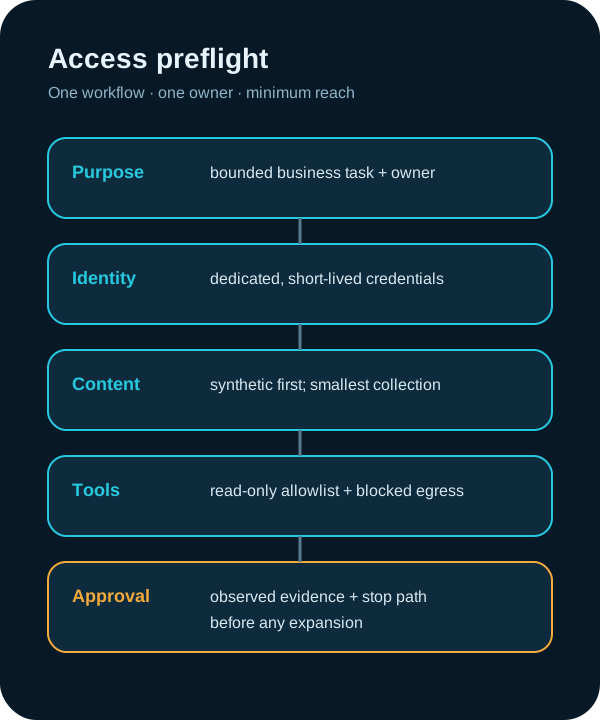
- Problem: a useful agent may inherit more content, tool and egress access than the task requires.
- Audience: security architects, content administrators, records teams, IT owners and application developers.
- Output: a signed preflight packet with identity, data, tool, destination, evidence and recovery boundaries.
Define one business task before choosing permissions
Write a one-sentence job such as “extract renewal dates from the synthetic contract pilot folder and draft a review list.” Name the business owner, data owner, security reviewer, runtime owner and expiration date. If the purpose cannot be bounded, the access cannot be justified.
Inventory the proposed service identity, content collections, labels, inherited permissions, connectors, tools, model provider, prompts, memory, external destinations and scheduled actions. Record whether each relationship is required, optional or prohibited. Shared user accounts and long-lived personal tokens should fail the preflight.
Create an independent truth set before connecting discovery or governance tools. Include one intentionally out-of-scope synthetic folder and one denied destination so the team can observe whether the boundary is enforced rather than merely configured.

- Identity: dedicated principal, owner, credential lifetime and revocation path.
- Content: exact pilot collection, labels, inheritance and excluded repositories.
- Actions: reads, writes, shares, deletes, exports, callbacks and scheduled jobs.
Build the permission matrix and evidence contract
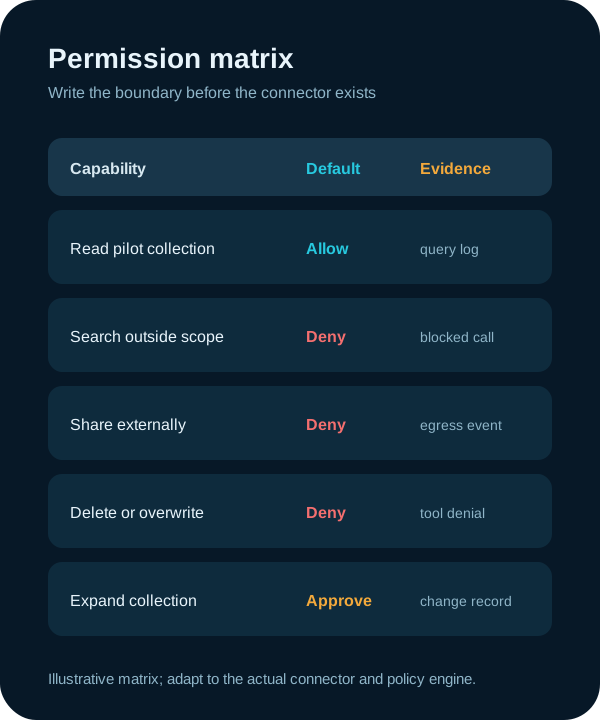
Default to deny. Allow only the reads and transformations required by the one task. Keep search outside the pilot collection, external sharing, delete, overwrite, permission changes and connector creation blocked. If a write is necessary later, add a human approval step and a reversible staging location.
For every allowed or denied capability, define the evidence expected: query log, object ID, actor, tool call, destination, policy result, before-and-after state and timestamp. A policy screenshot is not proof that runtime enforcement worked.
Example prompt for the preflight assistant: “Using only the supplied inventory and policy rows, produce a permission matrix for the named workflow. Cite the source row for every identity, collection, tool and destination. Mark required, denied, human-approved or unknown. Identify inherited access and missing telemetry. Do not recommend broader access, create credentials or claim a control is enforced without an observed test.”
Run a synthetic, observable pilot
Use synthetic documents that resemble the structure but not the secrets of production content. Seed harmless canary records, one benign instruction that should not change the agent's task, and an approved test destination that records attempted egress without exposing data. Keep production repositories and real recipients disconnected.
Observe ordinary reads, out-of-scope searches, attempted external shares, tool failures, prompt or document instructions, retries and scheduled activity. Test the stop control, credential revocation, queued-job behavior and recovery with fresh authorization. Do not turn a red-team idea into an uncontrolled production test.
The expected output is a discrepancy list between the truth set, configured boundary and observed behavior. The assistant may group and summarize events; administrators verify the source logs and decide whether the workflow can advance.

Require a gate before production content
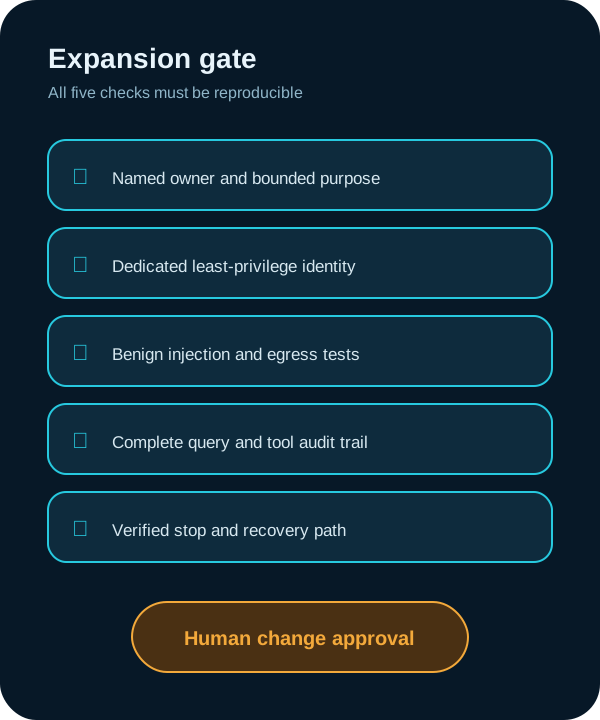
Advance only when the named owner, dedicated identity, minimum content scope, blocked actions, complete audit trail, benign injection tests and stop-and-recovery path are independently verified. Record the exact agent, prompt, connector and policy versions covered by the approval.
Measure unexplained access, denied actions that succeeded, missing tool calls, policy-to-runtime mismatches, external-destination attempts, ownerless credentials, recovery time and reviewer effort. Establish thresholds from your own risk tolerance and baseline; no cited source proves a universal safe rate.
Expand one dimension at a time—collection, action or destination—and repeat the evidence gate. A future vendor feature may help automate detection or records policy, but it does not replace the organization's authorization and change decision.
Limitations and safe boundaries
Content systems may have nested groups, shared links, inherited permissions, search indexes and third-party connectors that make apparent scope incomplete. Agent memory and downstream tools can retain context after access is revoked.
Prompt injection detection is imperfect, and a benign synthetic test cannot represent every malicious document or tool response. Runtime visibility also depends on the logs, identity events and connector telemetry the organization actually retains.
This workflow does not prove an agent is safe. It creates a reviewable minimum boundary and a repeatable way to detect drift. Production use still needs data governance, identity lifecycle, DLP, incident response, records policy and accountable owners.
Put the insight into practice.
Deep Security helps organizations assess risk, validate controls, and build a practical plan to strengthen their defenses.
Talk with Deep Security